West · Pacific Flyway
Jays in California
Jays in California come down to 7 species with regular eBird records, led by the California Scrub-Jay. Together they account for 1,476,184 of the 62 million eBird records from 2020–2024 — 2.4% of everything reported in the state.
The full list: California Scrub-Jay, Steller's Jay, Pinyon Jay, Island Scrub-Jay, Woodhouse's Scrub-Jay, Canada Jay and Black-throated Magpie-Jay. Jays are the loud, intelligent, boldly colored members of the crow family. The Blue Jay dominates the East; the West has its own set — scrub-jays, Steller's Jay, Pinyon Jay, and the Canada Jay of the high forests — and the two sides overlap only along the Rockies.
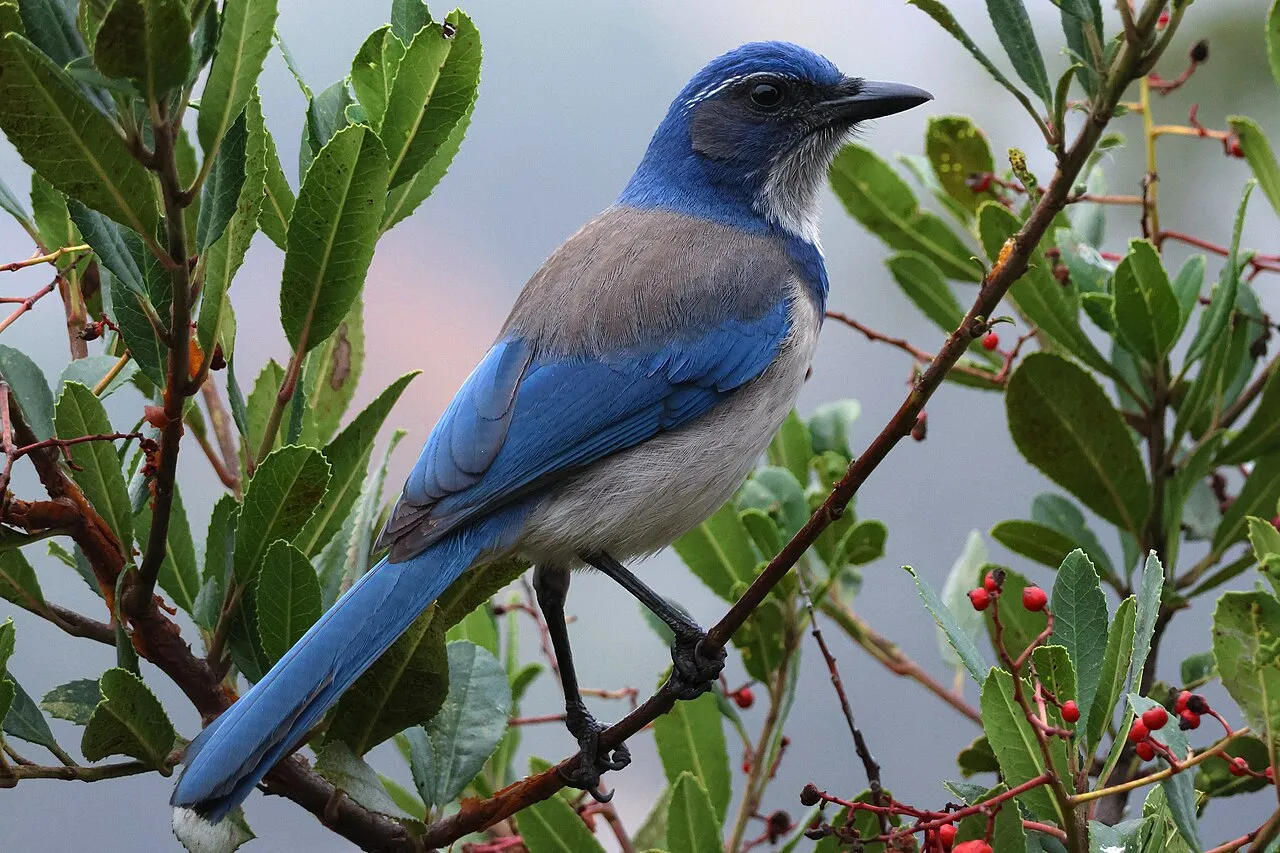
Jays in California: every species, most-reported first
Every jay with at least 25 eBird records in the state from 2020–2024, most-reported first. The status label is derived from each species’ own monthly share of all state records.
1. California Scrub-Jay (Aphelocoma californica) — 1,089,789 records, 1.8% of the state’s eBird total; a year-round resident, reported in every month.
2. Steller's Jay (Cyanocitta stelleri) — 372,804 records, 0.6% of the state’s eBird total; a year-round resident, reported in every month.
3. Pinyon Jay (Gymnorhinus cyanocephalus) — 5,675 records, 0.01% of the state’s eBird total; a summer visitor, present mainly from April to October and peaking in September.
4. Island Scrub-Jay (Aphelocoma insularis) — 3,195 records, 0.01% of the state’s eBird total; a year-round resident, reported in every month.
5. Woodhouse's Scrub-Jay (Aphelocoma woodhouseii) — 1,864 records, 0.00% of the state’s eBird total; a year-round resident, reported in every month.
6. Canada Jay (Perisoreus canadensis) — 1,679 records, 0.00% of the state’s eBird total; a summer visitor, present mainly from May to October and peaking in June.
7. Black-throated Magpie-Jay (Calocitta colliei) — 1,178 records, 0.00% of the state’s eBird total; a summer visitor, present mainly from February to October and peaking in August.
When to see jays in California
Adding up every species’ share of state eBird records month by month, jays are most prominent in June, July and September and least in January and November. 4 of the 7 species are year-round — California Scrub-Jay, Steller's Jay, Island Scrub-Jay and Woodhouse's Scrub-Jay — so there is no month without them.
Summer visitors. Pinyon Jay arrives around April and is mostly gone after October (peak September); Canada Jay arrives around May and is mostly gone after October (peak June); Black-throated Magpie-Jay arrives around February and is mostly gone after October (peak August).
Attracting jays to California backyards
Peanuts in the shell are the classic jay food; whole corn and sunflower work too. Jays cache what they cannot eat, so a platform feeder will empty faster than you expect.
In California the jay most likely to turn up is the California Scrub-Jay, a year-round resident, followed by the Steller's Jay. Its own page covers month-by-month activity and attraction tips for this state.
Jays in California: FAQ
How many species of jays are there in California?
7 species of jays have regular eBird records in California (at least 25 records in 2020–2024): California Scrub-Jay, Steller's Jay, Pinyon Jay, Island Scrub-Jay, Woodhouse's Scrub-Jay, Canada Jay and Black-throated Magpie-Jay.
What is the most common jay in California?
The California Scrub-Jay, with 1,089,789 eBird records in 2020–2024, followed by the Steller's Jay with 372,804. It is a year-round resident, reported in every month.
When is the best time to see jays in California?
June, July and September, when the combined share of California eBird records belonging to jays is highest. Summer visitors such as the Pinyon Jay arrive around April.
More birds in California
Jays in other states
Jays in California: sources
Every number on this page comes from the EOD – eBird Observation Dataset published by the Cornell Lab of Ornithology and distributed through GBIF under a CC BY 4.0 license: California records from 2020–2024, retrieved 2026-09-18. Species are drawn from the families Corvidae; only species with at least 25 records are listed, and a species is called a year-round resident when its monthly share of state records stays above 30% of its own peak in ten or more months. “Records” are individual eBird observations, so they reflect how often birders report a species, not a population count.