South · Atlantic Flyway
Hawks in Florida
Hawks in Florida come down to 8 species with regular eBird records, led by the Red-shouldered Hawk. Together they account for 793,313 of the 32 million eBird records from 2020–2024 — 2.5% of everything reported in the state.
The full list: Red-shouldered Hawk, Northern Harrier, Red-tailed Hawk, Cooper's Hawk, Short-tailed Hawk, Sharp-shinned Hawk, Broad-winged Hawk and Swainson's Hawk. Hawks range from the crow-sized accipiters that ambush songbirds at feeders to the broad-winged soaring buteos you see circling over highways. Many are year-round residents; others pass through in large numbers during spring and fall migration.
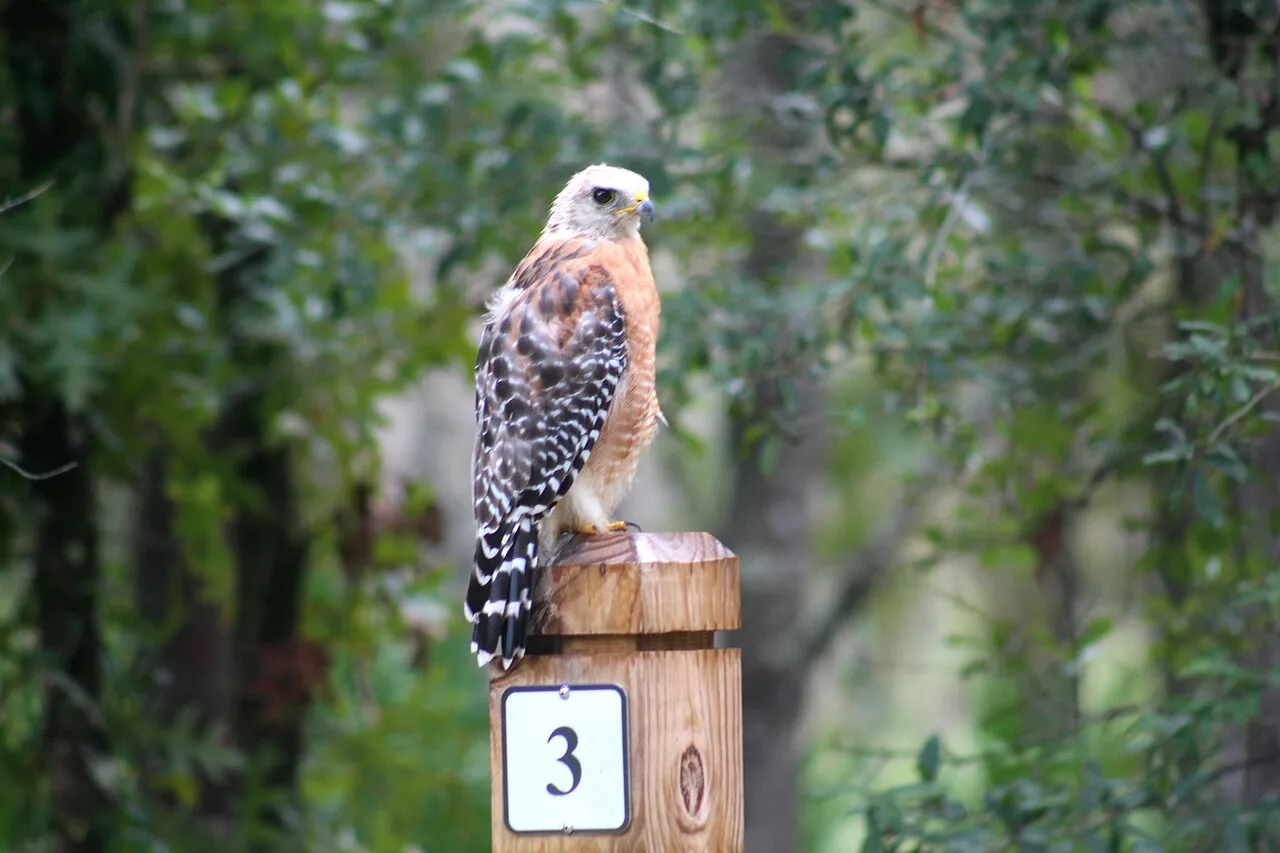
Hawks in Florida: every species, most-reported first
Every hawk with at least 25 eBird records in the state from 2020–2024, most-reported first. The status label is derived from each species’ own monthly share of all state records.
1. Red-shouldered Hawk (Buteo lineatus) — 515,818 records, 1.6% of the state’s eBird total; a year-round resident, reported in every month.
2. Northern Harrier (Circus cyaneus) — 85,500 records, 0.3% of the state’s eBird total; a winter visitor, present mainly from October to March and peaking in November.
3. Red-tailed Hawk (Buteo jamaicensis) — 70,194 records, 0.2% of the state’s eBird total; a year-round resident, reported in every month.
4. Cooper's Hawk (Astur cooperii) — 67,848 records, 0.2% of the state’s eBird total; a year-round resident, reported in every month.
5. Short-tailed Hawk (Buteo brachyurus) — 26,005 records, 0.08% of the state’s eBird total; a year-round resident, reported in every month.
6. Sharp-shinned Hawk (Accipiter striatus) — 15,944 records, 0.05% of the state’s eBird total; a winter visitor, present mainly from October to March and peaking in October.
7. Broad-winged Hawk (Buteo platypterus) — 10,192 records, 0.03% of the state’s eBird total; a passage migrant, reported mainly in April, September, October and November with a peak in October.
8. Swainson's Hawk (Buteo swainsoni) — 1,812 records, 0.01% of the state’s eBird total; a winter visitor, present mainly from October to January and peaking in November.
When to see hawks in Florida
Adding up every species’ share of state eBird records month by month, hawks are most prominent in October, November and December and least in April and May. 4 of the 8 species are year-round — Red-shouldered Hawk, Red-tailed Hawk, Cooper's Hawk and Short-tailed Hawk — so there is no month without them.
Winter visitors. Northern Harrier arrives around October and leaves after March (peak November); Sharp-shinned Hawk arrives around October and leaves after March (peak October); Swainson's Hawk arrives around October and leaves after January (peak November).
Passage migrants. Broad-winged Hawk is reported mainly in April, September, October and November.
Attracting hawks to Florida backyards
A hawk visiting a feeder is part of a healthy yard, not a problem to solve. Dense shrubs and brush piles within a few feet of feeders give small birds cover; if a hawk keys in on your feeder, taking it down for a few days usually moves the hawk along.
In Florida the hawk most likely to turn up is the Red-shouldered Hawk, a year-round resident, followed by the Red-tailed Hawk.
Hawks in Florida: FAQ
How many species of hawks are there in Florida?
8 species of hawks have regular eBird records in Florida (at least 25 records in 2020–2024): Red-shouldered Hawk, Northern Harrier, Red-tailed Hawk, Cooper's Hawk, Short-tailed Hawk, Sharp-shinned Hawk, Broad-winged Hawk and Swainson's Hawk.
What is the most common hawk in Florida?
The Red-shouldered Hawk, with 515,818 eBird records in 2020–2024, followed by the Northern Harrier with 85,500. It is a year-round resident, reported in every month.
When is the best time to see hawks in Florida?
October, November and December, when the combined share of Florida eBird records belonging to hawks is highest. Winter visitors such as the Northern Harrier arrive around October.
More birds in Florida
Hawks in other states
Hawks in Florida: sources
Every number on this page comes from the EOD – eBird Observation Dataset published by the Cornell Lab of Ornithology and distributed through GBIF under a CC BY 4.0 license: Florida records from 2020–2024, retrieved 2026-09-18. Species are drawn from the families Accipitridae; only species with at least 25 records are listed, and a species is called a year-round resident when its monthly share of state records stays above 30% of its own peak in ten or more months. “Records” are individual eBird observations, so they reflect how often birders report a species, not a population count.