Columbidae · reviewed profile
Mourning Dove
Zenaida macroura
The mourning dove is the slender tan dove with the soft, sad-sounding coo, one of the most abundant birds in North America with a U.S. population estimated at 350 million 1.
This profile draws on the Cornell Lab of Ornithology's All About Birds accounts 12 and on eBird records from the nine states covered on this site 3.
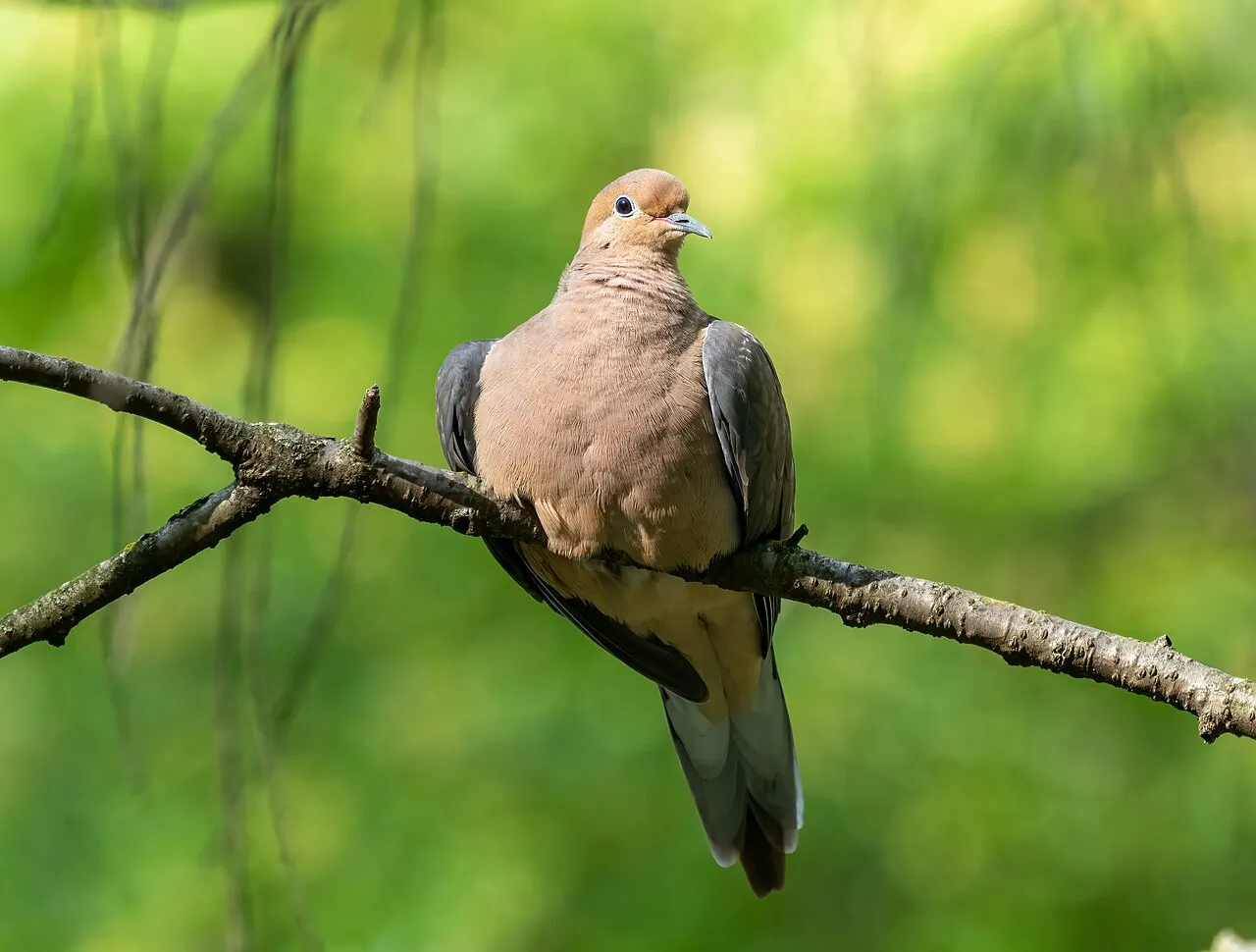
Mourning dove identification and behavior
Mourning doves feed on the ground and in the open, pecking or pushing aside litter rather than scratching. Males defend favorite cooing perches from other males, and pairs preen each other around the neck before grasping beaks and bobbing heads in unison 2. In the breeding season you may see three doves flying in tight formation: a mated male in the lead, an unmated rival chasing him, and the female following 1.
Doves swallow seeds and store them in the crop, an enlargement of the esophagus — the record is 17,200 bluegrass seeds in one crop — then fly to a safe perch to digest 1. They can drink brackish water up to almost half the salinity of seawater without dehydrating, one reason they survive in deserts 1.
Mourning dove habitat and range
Primarily a bird of open country, scattered trees and woodland edges, though large numbers roost in woodlots in winter; they feed on the ground in grasslands, agricultural fields, backyards and roadsides 2.
Mourning dove diet and feeder foods
Seeds make up 99 percent of the diet — cultivated grains, peanuts, wild grasses, weeds and herbs, occasionally berries and snails — and a dove eats roughly 12 to 20 percent of its body weight per day, about 71 calories on average 2.
To attract them, scatter seed, particularly millet, on the ground or on platform feeders, plant dense shrubs or evergreens for nesting, and keep cats indoors, because ground-feeding birds are especially vulnerable 1.
Mourning dove nesting
Doves nest amid dense foliage on the branch of an evergreen, orchard tree, mesquite, cottonwood or vine, quite often on the ground in the West, and untroubled by people — on gutters, eaves or abandoned equipment; the nest is a flimsy assembly of pine needles and twigs 2. The clutch is two unmarked white eggs, incubated 14 days, with young leaving after 12–15 days; a pair can raise up to six broods a year 2.
Conservation status
Mourning doves are common across the continent and have generally prospered as people settled the landscape, though populations declined by an estimated 0.4% per year from 1966 to 2019, about 20% in total, according to the North American Breeding Bird Survey; Partners in Flight estimates the global breeding population at 150 million and rates the species 6 out of 20 2. It is also the continent's most popular game bird, with hunters taking more than 20 million a year 12. The oldest known dove was at least 30 years, 4 months old 1.
Mourning Dove by state: eBird records
Across the nine states with eBird occurrence data on this site (records from 2020–2024), the Mourning Dove is reported most often in California, where it ranks #5 among all species with 1,160,123 records.
Attracting them to your yard
Serve · best foods
- millet
- cracked corn
- sunflower chips
Plant · useful plants
- native grasses
- sunflower
- coneflower
Place · best feeders
- ground tray
- platform feeder
Frequently asked questions
What do mourning doves eat?
Seeds — 99 percent of the diet — including grain, peanuts, grass and weed seeds; at feeders, millet scattered on the ground or on a platform 12.
How many times a year do mourning doves nest?
Up to six broods a year, each of two white eggs incubated for 14 days 2.
Where do mourning doves nest?
On branches in dense foliage, on the ground in the West, and readily on gutters, eaves and other human structures 2.
What feeder is best for mourning doves?
A platform feeder or seed scattered on the ground; they do not use tube feeders well 1.