Cardinalidae · reviewed profile
Northern Cardinal
Cardinalis cardinalis
The northern cardinal is the crested red songbird of eastern and central North America, abundant in backyards and the state bird of seven states — Illinois, Indiana, Kentucky, North Carolina, Ohio, Virginia and West Virginia 1.
This profile draws on the Cornell Lab of Ornithology's All About Birds accounts 12 and on eBird records from the nine states covered on this site 3.
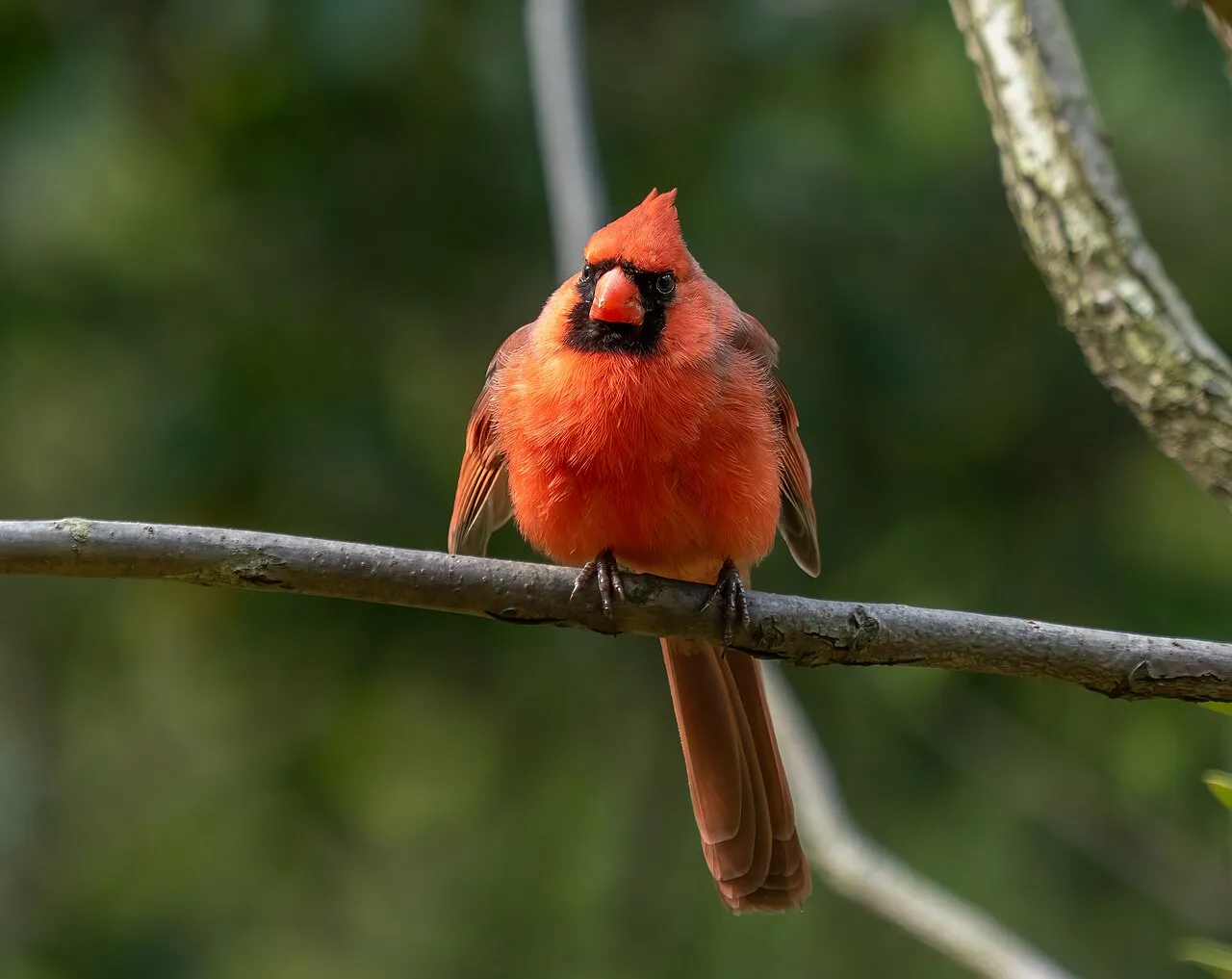
Northern cardinal identification and behavior
Cardinals hop through low branches and forage on or near the ground, and sing and preen from a high branch of a shrub; the crest is raised when the bird is agitated and lowered almost flat at rest 2. They move in pairs during the breeding season, but in fall and winter form flocks of a dozen to several dozen birds, sometimes foraging with juncos, sparrows, titmice and goldfinches 2.
Unusually among North American songbirds, the female cardinal sings, often while on the nest, which may tell the male when to bring food; her song can be longer and more complex than his 1. Cardinals are also the bird most often seen attacking their own reflection in a window or car mirror in spring and early summer, when both sexes are defending territory; the attacks stop a few weeks later as hormone levels fall 1.
Northern cardinal habitat and range
Look for cardinals in dense shrubby areas: forest edges, overgrown fields, hedgerows, backyards, marshy thickets, mesquite, regrowing forest and ornamental landscaping. They nest in dense foliage and look for conspicuous, fairly high perches for singing. The growth of towns and suburbs across eastern North America has helped the species expand its range northward 2.
Northern cardinal diet and feeder foods
Cardinals eat mainly seeds and fruit, supplemented with insects, and feed their nestlings mostly insects. Wild foods include dogwood, wild grape, buckwheat, grasses, sedges, mulberry, hackberry, blackberry, sumac, tulip-tree and corn; insect prey includes beetles, crickets, katydids, leafhoppers, cicadas, flies, spiders, butterflies and moths 2. At feeders they eat many kinds of birdseed, particularly black oil sunflower 2.
Nearly any feeder within their range ought to attract cardinals, but they particularly use sunflower seeds; leaving undergrowth in the yard or around its edges can bring a nesting pair 1.
Northern cardinal nesting
A week or two before building, the female visits possible sites with the male following, the pair calling back and forth and holding nesting material as they assess each spot. Nests are wedged into a fork of small branches in a sapling, shrub or vine tangle, 1–15 feet up and hidden in dense foliage 2.
Clutches are 2–5 eggs, grayish, buffy or greenish white speckled with gray to brown, incubated 11–13 days; the young leave after 7–13 days and pairs raise 1–2 broods a year 2.
Conservation status
The expansion of agricultural and suburban habitat over the last two centuries has been good for cardinals, which are abundant in eastern and central North America. Breeding Bird Survey numbers have increased by an estimated 0.32% per year since 1966; Partners in Flight estimates a global breeding population of 130 million and rates the species 6 out of 20 on the Continental Concern Score 2. The oldest recorded northern cardinal was a female of 15 years, 9 months 1.
Northern Cardinal by state: eBird records
Across the nine states with eBird occurrence data on this site (records from 2020–2024), the Northern Cardinal is reported most often in Texas, where it ranks #1 among all species with 1,144,271 records. It is rare or absent in Colorado, California, Oregon.
Attracting them to your yard
Serve · best foods
- black-oil sunflower seeds
- safflower
- cracked corn
- berries
Plant · useful plants
- flowering dogwood
- American elderberry
- serviceberry
Place · best feeders
- platform feeder
- large hopper feeder
Frequently asked questions
What do northern cardinals eat?
Mainly seeds and fruit — dogwood, wild grape, mulberry, sumac, grasses and many others — plus insects, which are the main food for nestlings. At feeders, black oil sunflower seed above all 2.
Why is a cardinal attacking my window?
It is fighting its own reflection while defending territory in spring and early summer; both males and females do it, and it stops as aggressive hormone levels subside a few weeks later 1.
Do female cardinals sing?
Yes — the northern cardinal is one of the few North American songbirds in which the female sings, often from the nest 1.
Where do cardinals nest?
In a fork of small branches in a sapling, shrub or vine tangle, 1–15 feet up and hidden in dense foliage; 2–5 eggs, 1–2 broods a year 2.