Spring · March–May · Baeolophus bicolor
Tufted Titmouse in Spring
The tufted titmouse in spring needs a hole it cannot make: titmice nest in cavities but cannot excavate their own, so they use natural holes and old nest holes of woodpeckers including Pileated Woodpecker and Northern Flicker, as well as nest boxes, fence posts and metal pipes 3.
Behavior is from All About Birds 3, feeding from Project FeederWatch 2, and the state numbers from eBird records on this site 1. The eBird section on this page is computed from the dataset itself: for each of the nine states with occurrence data on this site, it shows the species' share of all eBird records in these months against its share across the year, so you can see where the season actually concentrates the bird 1.
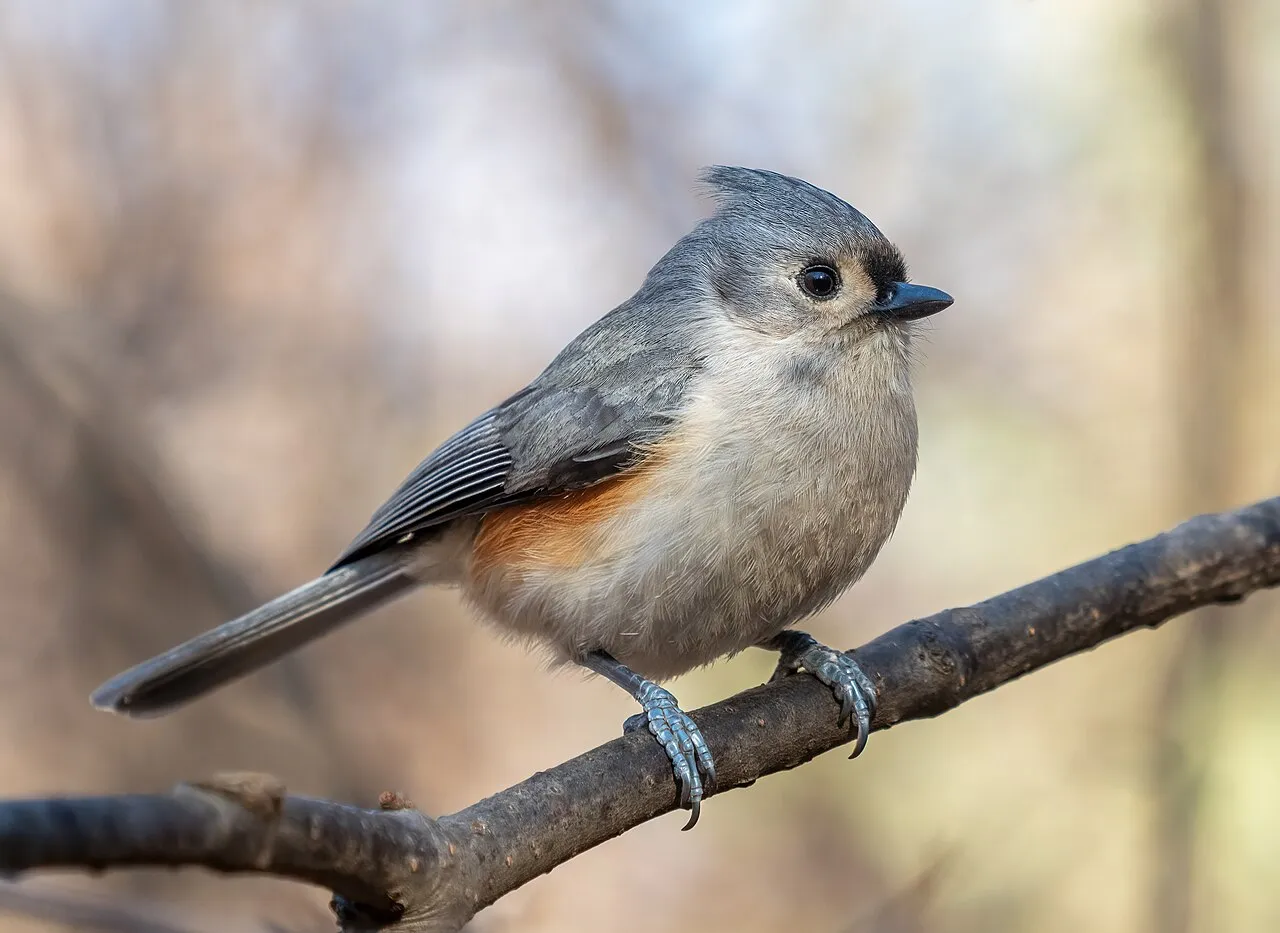
What the tufted titmouse in spring is doing
Unlike chickadees, titmouse pairs do not gather into larger flocks outside the breeding season; most stay on their territory as a pair, often with one of the previous year's young, and occasionally a young bird stays into the next breeding season to help raise the brood 3. Clutches are 3–9 white eggs spotted with chestnut, brown or lilac, incubated 12–14 days; the young leave after 15–16 days, one brood a year 3. By summer the diet is mainly insects — caterpillars, beetles, ants, wasps, stink bugs and treehoppers — plus spiders and snails, after a winter of seeds, nuts and hoarded sunflower 3.
Where to look for titmice in spring
Titmice live in deciduous or mixed evergreen-deciduous woods with a dense canopy and many tree species, and are common in orchards, parks and suburbs; they are rarely reported above 2,000 feet 3. They flit from branch to branch of the canopy, often with nuthatches, chickadees, kinglets and woodpeckers, and are acrobatic foragers that hang upside down or sideways to check cones and leaf clusters 3. The range has been expanding northward over the last half-century, possibly because of a warming climate, farmland reverting to forest and the popularity of backyard feeders 3; the eBird cards below show it as an eastern bird, absent from the western states on this site 1.
Hosting titmice in spring
Putting up a nest box well before the breeding season, with a predator guard, is a good way to attract a breeding pair, and the species' dependence on dead wood is a reason to leave dead trees standing where it is safe 3. Titmice remain feeder regulars, preferring sunflower seeds and also taking suet and peanuts 3; they hold a seed with their feet and hammer it open 3. Clean feeders every week or two and more often in wet weather 2.
eBird records by state: Tufted Titmouse, March–May
In March–May the Tufted Titmouse makes up the largest share of eBird records in Tennessee (2.9% of all records, against 3.0% across the year). The season raises its share above the annual figure in Rhode Island. Records are eBird checklists reported 2020–2024 and retrieved through GBIF.