Spring · March–May
Spring Birds
Spring birds announce themselves: the Baltimore Oriole's whistling song from the treetops is a herald of spring across eastern North America, and the brightening yellow of male goldfinches is a mark of approaching warm months 34.
The behavior below is from All About Birds species accounts [3–8], feeding advice from Project FeederWatch 2, and the state-by-state numbers from eBird records on this site 1.
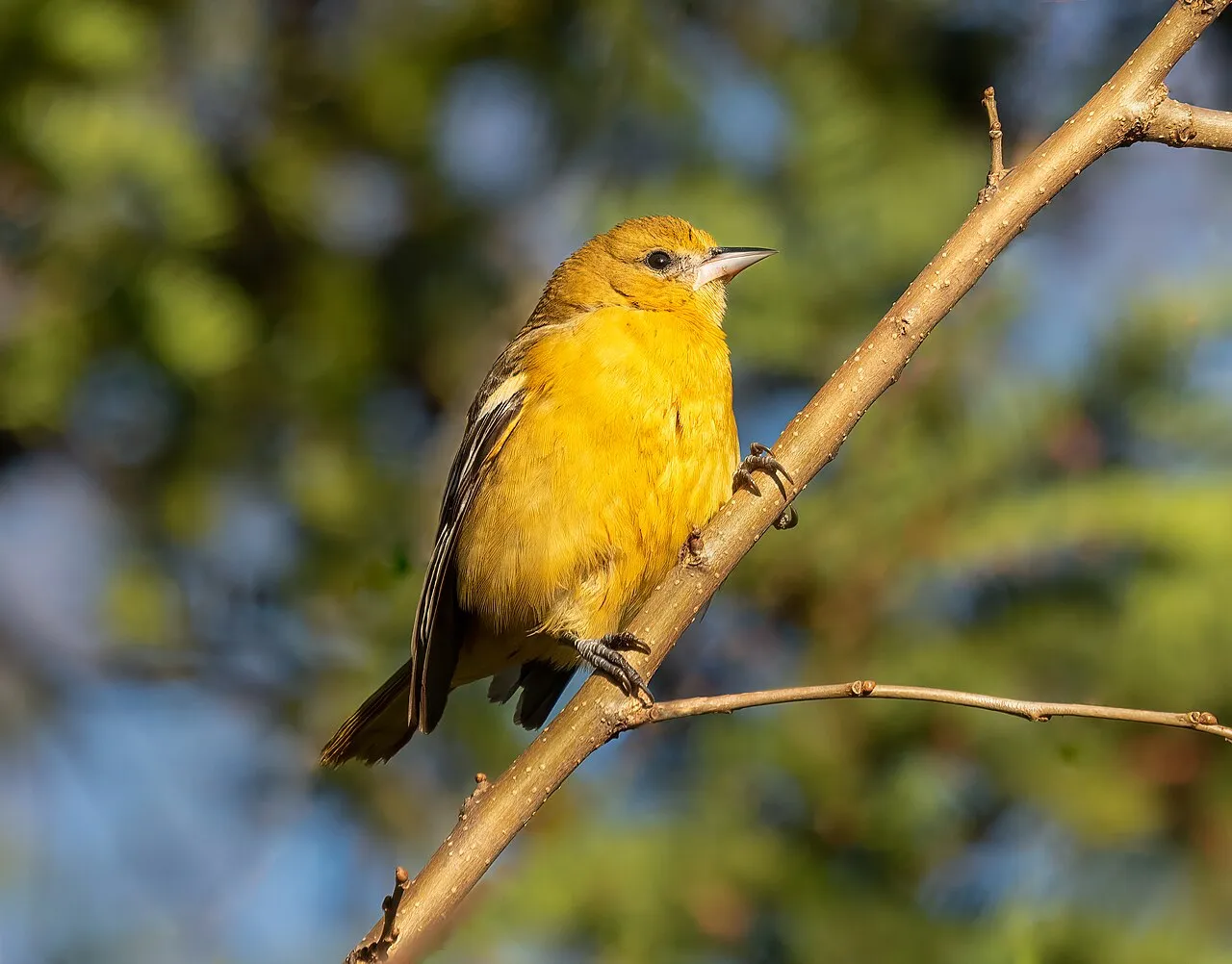
Spring birds arriving and changing
Orioles return from Central America in spring, when nectar and ripe fruit make up more of the diet than in summer — the window for orange halves and jelly 3. Goldfinches finish their late-winter molt and the males turn yellow 4. Ruby-throated Hummingbirds arrive to breed in deciduous woodlands, old fields, forest edges, orchards and backyards; the pairs stay together only days to weeks 5. Robins are singing: in spring males attract females by singing, raising and spreading the tail and inflating the white-striped throat, and the birds shift from winter fruit back to earthworms on lawns 6.
Spring birds settling in to nest
Northern Cardinals are the bird most often seen attacking their own reflection in windows and car mirrors in spring and early summer, when both sexes defend territory; it stops a few weeks later as hormone levels fall 7. A week or two before building, the female visits possible sites with the male following, and nests go into a fork of small branches in a sapling, shrub or vine tangle 7. Black-capped Chickadees excavate their own cavities in dead snags or rotten branches, frequently alder or birch, or take a nest box put up well before the breeding season and filled with sawdust or shavings 8. Tufted Titmice, which cannot excavate, take natural holes, old woodpecker holes and boxes 9.
Spring is also when feeder hygiene matters most: clean feeders more often in wet weather, and switch hummingbird feeders to a one-to-four sugar-water mix with no dye as the first birds arrive 2.
The most seasonal spring birds by state, from eBird
For each state with eBird data on this site, these are the backyard species whose share of March–May records rises most above their year-round share — the birds that are most a spring bird there. Records are eBird checklists reported 2020–2024, retrieved through GBIF.
Florida: Orchard Oriole (2.5× its annual share), Painted Bunting (2.3× its annual share), Rose-breasted Grosbeak (1.9× its annual share), Cedar Waxwing (1.9× its annual share)
Arizona: Rose-breasted Grosbeak (1.8× its annual share), Pine Siskin (1.5× its annual share), Yellow Warbler (1.5× its annual share), Evening Grosbeak (1.5× its annual share)
California: Rufous Hummingbird (2.2× its annual share), Black-headed Grosbeak (2.1× its annual share), Calliope Hummingbird (2.0× its annual share), Lazuli Bunting (2.0× its annual share)
Colorado: Rose-breasted Grosbeak (2.2× its annual share), Summer Tanager (2.2× its annual share), Palm Warbler (1.8× its annual share), Black-and-white Warbler (1.7× its annual share)
Oregon: Orange-crowned Warbler (1.8× its annual share), Nashville Warbler (1.7× its annual share), Evening Grosbeak (1.6× its annual share), Calliope Hummingbird (1.5× its annual share)
Tennessee: Yellow Warbler (2.0× its annual share), Baltimore Oriole (1.9× its annual share), Orchard Oriole (1.8× its annual share), Brown-headed Cowbird (1.7× its annual share)
Texas: Scarlet Tanager (2.5× its annual share), Rose-breasted Grosbeak (2.4× its annual share), American Redstart (2.1× its annual share), Lazuli Bunting (1.9× its annual share)
Michigan: Summer Tanager (1.7× its annual share), Brown-headed Cowbird (1.6× its annual share), Orchard Oriole (1.6× its annual share), Palm Warbler (1.6× its annual share)
Rhode Island: Black-and-white Warbler (2.0× its annual share), Rose-breasted Grosbeak (2.0× its annual share), Brown-headed Cowbird (2.0× its annual share), Baltimore Oriole (2.0× its annual share)
Spring guides by species
Frequently asked questions
What are the first spring birds to arrive?
In the East, Baltimore Orioles by song, ruby-throated hummingbirds at feeders, and robins singing on lawns; cardinals and chickadees never left 356.
Why is a cardinal attacking my window in spring?
It is fighting its reflection while defending territory; both sexes do it, and it stops as hormone levels subside a few weeks later 7.
Sources
- EOD – eBird Observation Dataset, Cornell Lab of Ornithology, via GBIF.org (CC BY 4.0); monthly records 2020–2024 for the nine states on this site
- Project FeederWatch (Cornell Lab of Ornithology) — Feeding Birds
- All About Birds (Cornell Lab of Ornithology) — Baltimore Oriole: Overview and Life History
- All About Birds (Cornell Lab of Ornithology) — American Goldfinch: Overview and Life History
- All About Birds (Cornell Lab of Ornithology) — Ruby-throated Hummingbird: Overview and Life History
- All About Birds (Cornell Lab of Ornithology) — American Robin: Overview and Life History
- All About Birds (Cornell Lab of Ornithology) — Northern Cardinal: Overview and Life History
- All About Birds (Cornell Lab of Ornithology) — Black-capped Chickadee: Overview and Life History
- All About Birds (Cornell Lab of Ornithology) — Tufted Titmouse: Overview and Life History