Turdidae · reviewed profile
American Robin
Turdus migratorius
The american robin (Turdus migratorius) is the large orange-breasted thrush of lawns and parks across the continent — and, contrary to the "first robin of spring" tradition, a bird many people have all year without noticing 1.
This profile draws on the Cornell Lab of Ornithology's All About Birds accounts 12 and on eBird records from the nine states covered on this site 3.
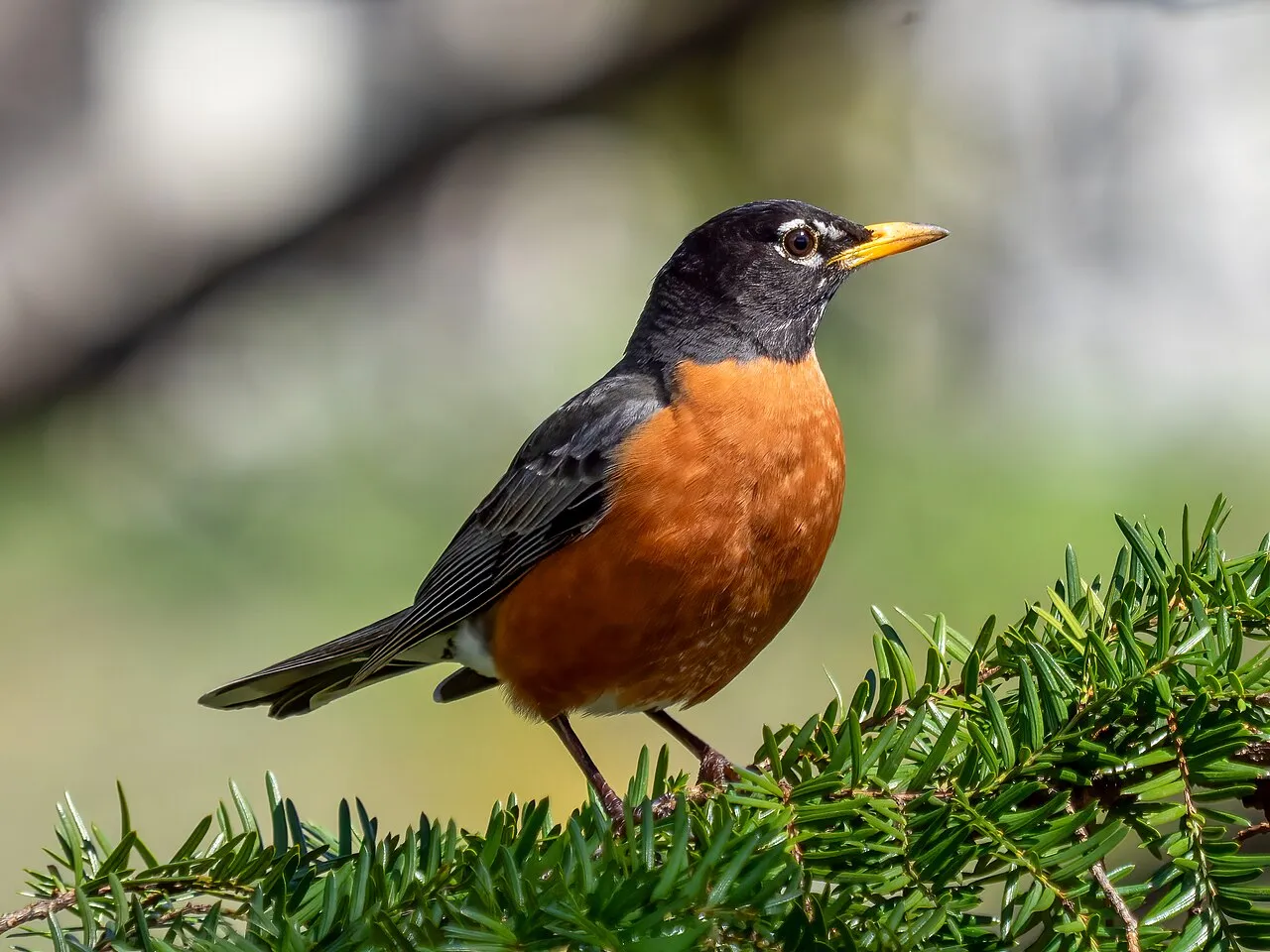
American robin identification and behavior
On the ground a robin runs a few steps, then stops abruptly; in long grass it may hop or fly just above the ground with slow, powerful wingbeats. Robins find worms by staring motionless at the ground with the head cocked, and will fight over worms other robins have caught 2. In spring, males attract females by singing, raising and spreading the tail, shaking the wings and inflating the white-striped throat 2.
Robins eat different foods at different times of day — more earthworms in the morning, more fruit later — and when they feed exclusively on honeysuckle berries they sometimes become intoxicated 1.
American robin habitat and range, and why they seem to vanish in winter
Robins are common across the continent on lawns, fields and city parks as well as in woodlands, forests, mountains up to near treeline, recently burned forests and tundra; in winter many move to moist woods where berry-producing trees and shrubs are common 2.
Many robins spend the whole winter in their breeding range, but they spend more time roosting in trees and less on lawns, so you are much less likely to see them; winter roosts can be huge, sometimes a quarter-million birds 1. How many stay in the north varies each year with local conditions 1.
American robin diet and feeder foods
Robins eat large numbers of both invertebrates and fruit. In spring and summer they take earthworms, insects and some snails; year-round they eat an enormous variety of fruit including chokecherries, hawthorn, dogwood, sumac and juniper berries, and one study suggests they may select fruits that have bugs in them 2.
Because robins forage largely on lawns, they are vulnerable to pesticide poisoning and can be an indicator of chemical pollution — the strongest reason to keep a robin-friendly yard pesticide-free 2.
American robin nesting
Females choose the site, typically on one or several horizontal branches hidden in or just below a layer of dense leaves, usually in the lower half of a tree; robins also nest in gutters, eaves, on outdoor light fixtures and other structures 2. Clutches are 3–5 sky-blue or blue-green eggs, incubated 12–14 days, with the young leaving after about 13 days; a pair can raise 1–3 broods a year 2.
Success is low: on average only 40 percent of nests produce young, only a quarter of fledglings survive to November, and about half the robins alive in a year make it to the next, so the whole population turns over about every six years even though a lucky robin can live 14 years 1.
Conservation status
American robins are numerous and widespread; populations increased slightly, by about 0.13% per year from 1966 to 2019, according to the North American Breeding Bird Survey. Partners in Flight estimates the global breeding population at 370 million and rates the species 5 out of 20 on the Continental Concern Score 2.
American Robin by state: eBird records
Across the nine states with eBird occurrence data on this site (records from 2020–2024), the American Robin is reported most often in Michigan, where it ranks #2 among all species with 636,900 records.
Attracting them to your yard
Serve · best foods
- mealworms
- fresh or soaked dried fruit
- native berries
Plant · useful plants
- serviceberry
- crabapple
- winterberry
Place · best feeders
- ground tray
- platform feeder
Frequently asked questions
What does an american robin eat?
Earthworms, insects and snails — especially in spring and summer — plus a wide range of fruit such as chokecherry, hawthorn, dogwood, sumac and juniper 2.
What is the scientific name of the american robin?
Turdus migratorius. It is a thrush, not a close relative of the European robin 1.
Do robins migrate?
Some do, but many spend the whole winter in their breeding range, roosting in trees and feeding on fruit rather than on lawns, which is why they seem to disappear 1.
How long do american robins live?
A lucky robin can reach 14 years, but on average the population turns over every six years 1.