Icteridae · reviewed profile
Baltimore Oriole
Icterus galbula
The baltimore oriole's rich, whistling song from the treetops is a herald of spring across eastern North America, and the male's brilliant orange plumage blazes from high branches like a torch 1.
This profile draws on the Cornell Lab of Ornithology's All About Birds accounts 12 and on eBird records from the nine states covered on this site 3.
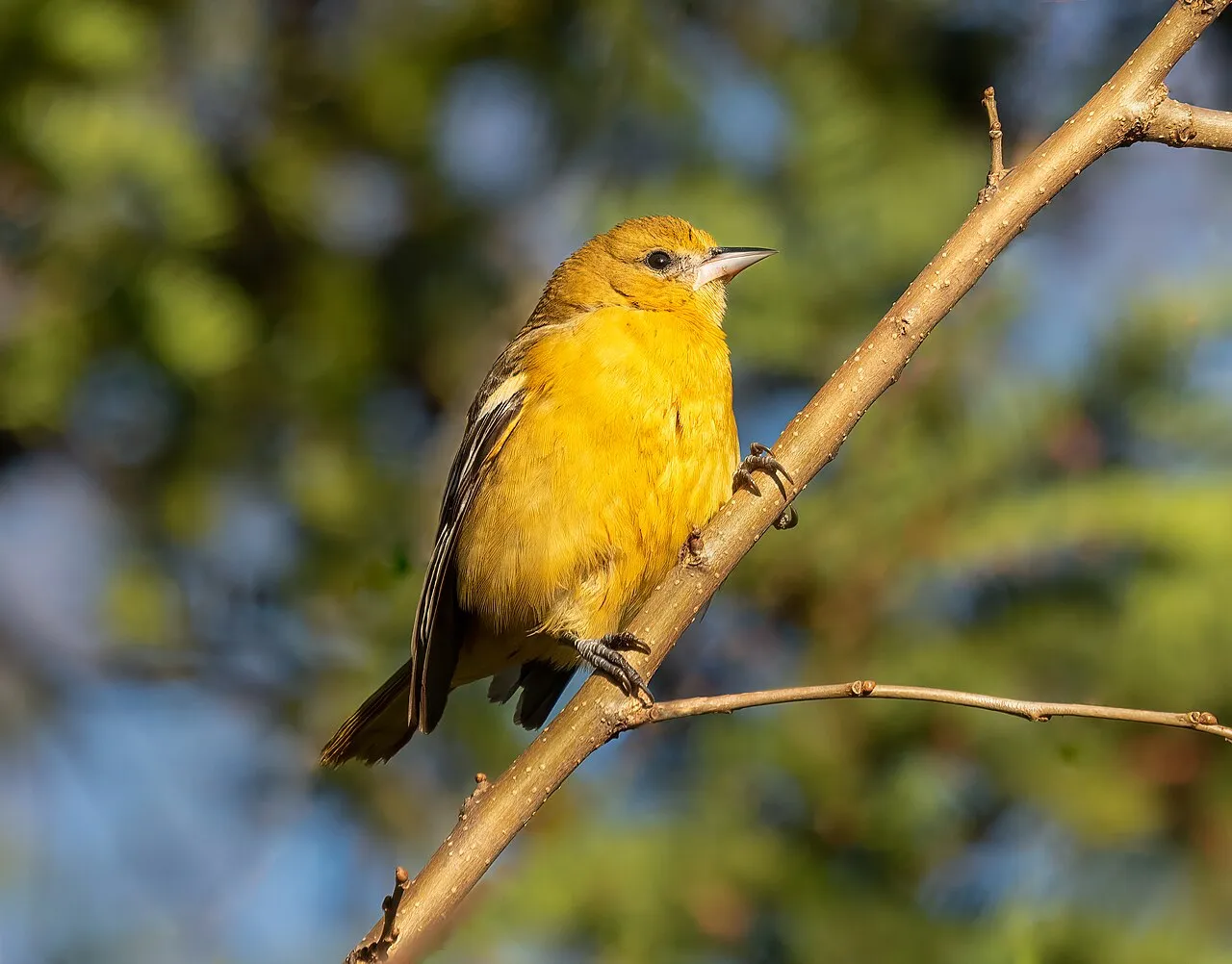
Baltimore oriole identification and behavior
Orioles are agile, acrobatic feeders that comb the high branches for insects, flowers and fruit, clambering across twigs, hanging upside down and fluttering to extend their reach, and flying out from perches to snatch insects in the air; males sing from conspicuous posts at the tops of trees 2. Young males do not molt into bright orange until the fall of their second year, and females become deeper orange with every molt — some older females are almost as bright as males 1.
The Baltimore oriole hybridizes extensively with Bullock's Oriole where their ranges meet on the Great Plains; the two were lumped as the Northern Oriole for a time and separated again after genetic studies in the 1990s 1. American orioles are not related to Old World orioles: they belong to the blackbird and meadowlark family 1.
Baltimore oriole habitat and range
On their breeding grounds in eastern and east-central North America, orioles are found high in leafy deciduous trees but not in deep forest — open woodland, forest edge, river banks and small groves — and they have adapted well to people, feeding and nesting in parks, orchards and backyards 2. On their winter range in Central America they occupy open woodlands, gardens and shade-grown coffee and cacao plantations 2.
Baltimore oriole diet and feeder foods
Insects, fruit and nectar, in proportions that change with the season: in summer, while feeding young, much of the diet is protein-rich insects — beetles, crickets, grasshoppers, moths, flies, spiders and snails, including pests such as tent caterpillars and gypsy moth caterpillars; in spring and fall, nectar and ripe fruit make up more of the diet because their sugars convert readily to migration fat 2. Unlike robins, orioles seem to prefer only ripe, dark-colored fruit — the darkest mulberries, reddest cherries and deepest-purple grapes — and ignore green grapes and yellow cherries even when ripe 1.
To attract them, cut oranges in half and hang them from trees, offer sugar water in an oriole feeder, and put out small amounts of jelly — not so much that it can soil their feathers; planting raspberries, crab apples and trumpet vines can bring orioles back year after year 1.
Baltimore oriole nesting
The female chooses a site within her mate's territory and anchors the nest to a fork in slender upper branches, often in an American elm but also maples and cottonwoods; the remarkable sock-like nest is woven from slender fibers, usually 3–4 inches deep with a small opening on top and a bulging bottom chamber, and usually hangs below a branch 2. Clutches are 3–7 pale grayish or bluish-white eggs blotched with brown, black or lavender, incubated 11–14 days, with the young leaving after 11–14 days; one brood a year 2.
Conservation status
Baltimore oriole populations have declined throughout the range by an estimated 0.84% per year, a cumulative 36% between 1966 and 2019, according to the North American Breeding Bird Survey. Partners in Flight estimates the global breeding population at 12 million and rates the species 10 out of 20 on the Continental Concern Score; because it breeds in North America and winters in Central and South America, it is vulnerable to deforestation in many countries 2.
Baltimore Oriole by state: eBird records
Across the nine states with eBird occurrence data on this site (records from 2020–2024), the Baltimore Oriole is reported most often in Michigan, where it ranks #36 among all species with 146,315 records. It is rare or absent in California, Colorado, Arizona, Oregon.
Attracting them to your yard
Serve · best foods
- Insects and other natural invertebrates
- Ripe fruit in small fresh portions
- Flower nectar or correctly prepared sugar solution
Plant · useful plants
- Regionally native fruiting trees and shrubs
- Native nectar flowers
- Deciduous canopy trees
Place · best feeders
- Clean fruit feeder
- Clean nectar or oriole feeder
Frequently asked questions
What do baltimore orioles eat?
Insects in summer, nectar and ripe dark fruit in spring and fall; at feeders, orange halves, sugar water and small amounts of jelly 12.
When do baltimore orioles arrive?
In spring, when the male's song from the treetops is one of the first signs of the season in eastern North America; they winter in Central America 12.
What does a baltimore oriole nest look like?
A sock-like pouch woven from slender fibers, 3–4 inches deep, hanging from a fork in the upper branches of a tall tree, often an elm, maple or cottonwood 2.
Why is my oriole not fully orange?
Young males keep drab, female-like plumage until the fall of their second year 1.