Trochilidae · reviewed profile
Ruby-throated Hummingbird
Archilochus colubris
The ruby-throated hummingbird is eastern North America's only breeding hummingbird, yet it occupies the largest breeding range of any hummingbird on the continent 1.
This profile draws on the Cornell Lab of Ornithology's All About Birds accounts 12 and on eBird records from the nine states covered on this site 3.
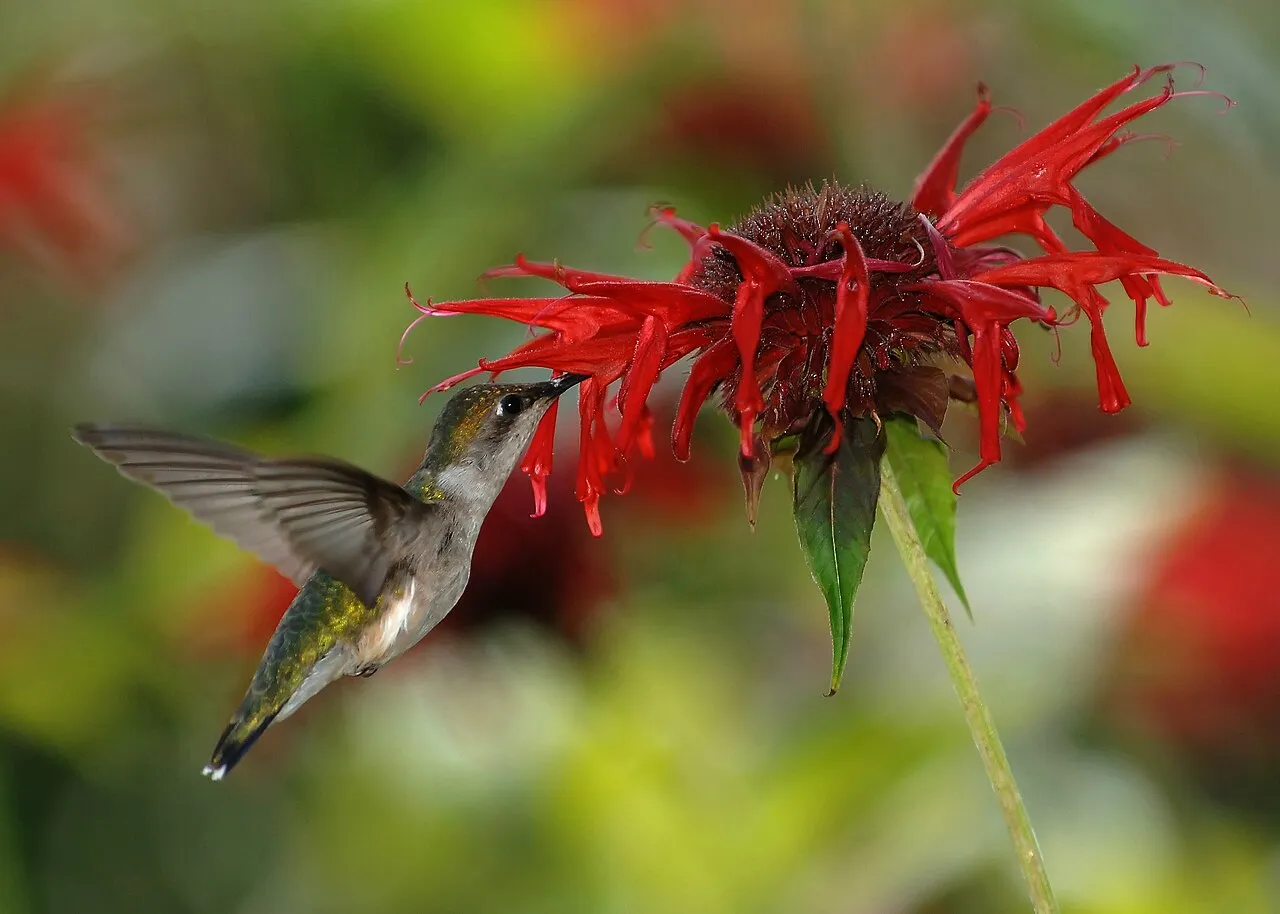
Ruby-throated hummingbird identification and behavior
Like all hummingbirds, ruby-throats are precision flyers that can stop in an instant, hang motionless, and move up, down, sideways and backwards; they dart between nectar sources or sit on a twig keeping watch 2. The wings beat about 53 times a second, and the legs are so short the bird cannot walk or hop — the best it can do is shuffle along a perch 1.
Males aggressively defend flowers and feeders, leading to spectacular chases 2, and they do not stay: pairs are together only days to weeks for courtship and mating, after which the male leaves and may begin migrating by early August 1. The oldest known bird was a female of at least 9 years, 2 months 1.
Ruby-throated hummingbird habitat and range
They breed in deciduous woodlands of eastern North America and across the Canadian prairies, in old fields, forest edges, meadows, orchards, stream borders and backyards; on their tropical wintering grounds they live in dry forest, citrus groves, hedgerows and scrub 2.
Ruby-throated hummingbird diet and feeder foods
Nectar of red or orange tubular flowers — trumpet creeper, cardinal flower, honeysuckle, jewelweed, bee-balm, red buckeye and red morning glory — plus hummingbird feeders and sometimes tree sap; they also catch mosquitoes, gnats, fruit flies and small bees in midair, pull insects from spider webs, and pick caterpillars and aphids from leaves 2. They prefer red or orange flowers, though there is no need to color feeder water 1.
Feeder recipe: about one-quarter cup of table sugar per cup of water, no food coloring; change the water before it grows cloudy, and remember that in hot weather sugar water ferments rapidly into toxic alcohol. Place feeders where cats cannot lie in wait and away from windows 12.
Ruby-throated hummingbird nesting
Females build the nest alone on a slender, often descending branch of a deciduous tree such as oak, hornbeam, birch, poplar or hackberry, usually 10–40 feet up — and sometimes on loops of chain, wire or extension cord 12. The nest takes 6–10 days to finish; clutches are 1–3 tiny white eggs weighing about half a gram, incubated 12–14 days, with the young leaving after 18–22 days; 1–2 broods a year 2.
Conservation status
Ruby-throated hummingbird populations steadily increased every year from 1966 to 2019 according to the North American Breeding Bird Survey; Partners in Flight estimates a global breeding population of 36 million and rates the species 8 out of 20. Feeders are generally safe, but can be a problem if they make birds easy targets for cats or are placed near windows 2.
Ruby-throated Hummingbird by state: eBird records
Across the nine states with eBird occurrence data on this site (records from 2020–2024), the Ruby-throated Hummingbird is reported most often in Texas, where it ranks #55 among all species with 169,438 records. It is rare or absent in California, Colorado, Arizona, Oregon.
Attracting them to your yard
Serve · best foods
- plain white sugar solution at 1:4 sugar-to-water
- natural flower nectar
Plant · useful plants
- cardinal flower
- trumpet honeysuckle
- native salvia
Place · best feeders
- hummingbird feeder
Frequently asked questions
What is the correct sugar-water recipe for hummingbirds?
About one-quarter cup of plain table sugar per cup of water, with no food coloring; replace it before it turns cloudy, and more often in hot weather 1.
When do ruby-throated hummingbirds leave?
Males may begin migrating by early August; the species winters in Mexico and Central America 12.
What flowers attract ruby-throated hummingbirds?
Red or orange tubular flowers: trumpet creeper, cardinal flower, honeysuckle, jewelweed, bee-balm, red buckeye and red morning glory 2.
Do hummingbirds eat insects?
Yes — mosquitoes, gnats, fruit flies, small bees, spiders, caterpillars and aphids 2.