Fringillidae · reviewed profile
American Goldfinch
Spinus tristis
The american goldfinch is the small bright-yellow finch of weedy fields and feeders, one of the strictest vegetarians in the bird world and one of the latest nesters in North America 1.
This profile draws on the Cornell Lab of Ornithology's All About Birds accounts 12 and on eBird records from the nine states covered on this site 3.
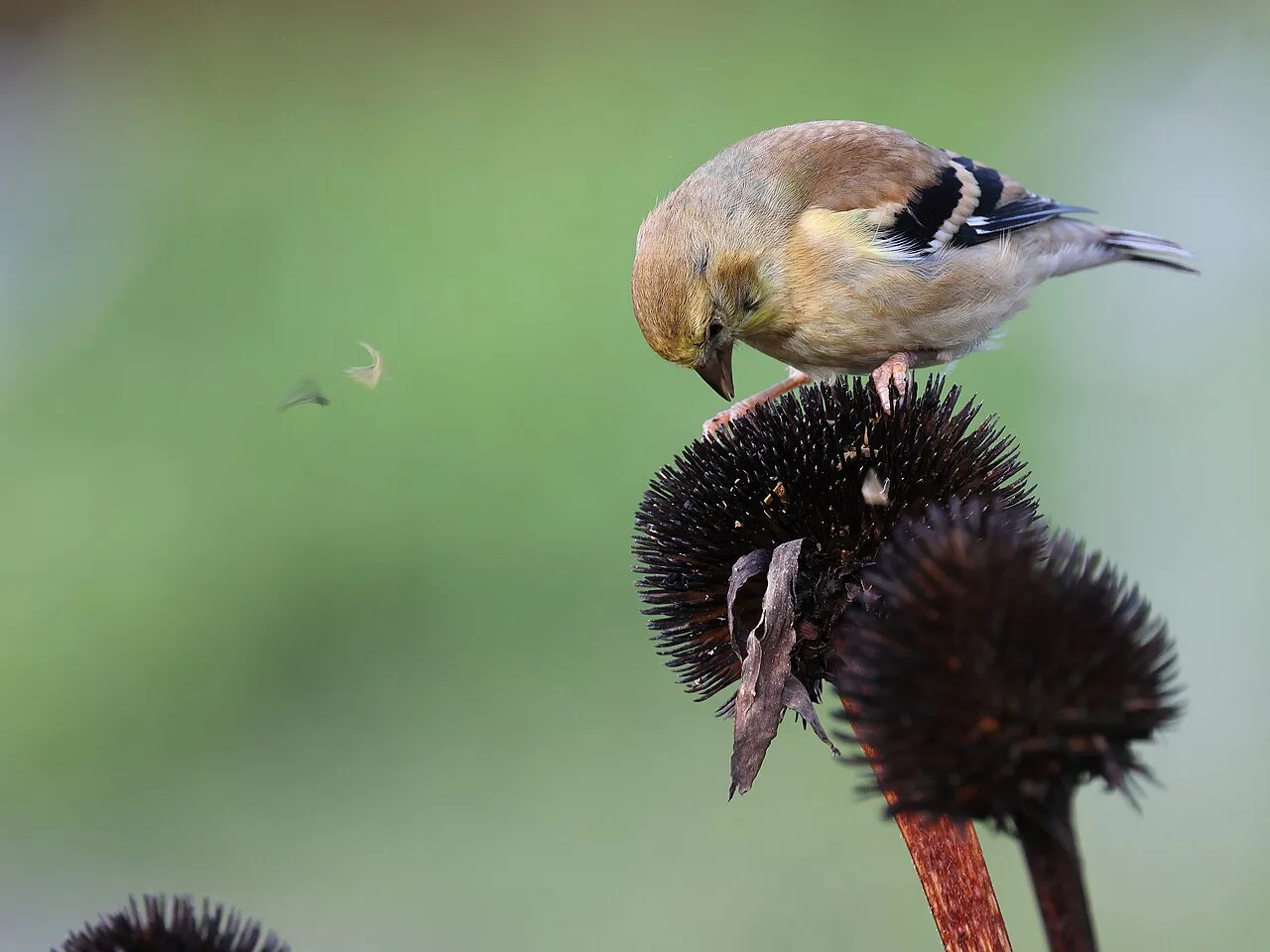
American goldfinch identification and behavior
Goldfinches are unusual among finches in molting their body feathers twice a year, once in late winter and again in late summer, so the brightening yellow of males each spring is a mark of approaching warm months 1. They are active, acrobatic birds that balance on the seedheads of thistles and dandelions to pluck seeds, with a bouncy flight and the frequent po-ta-to-chip call; unlike most songbirds they do not join in mobbing predators 2.
Paired goldfinches make virtually identical flight calls, and may recognise members of other pairs by them 1. The oldest known bird was 10 years, 9 months old 1.
Where american goldfinches live
Weedy fields, open floodplains and other overgrown areas with sunflower, aster and thistle for food and some shrubs and trees for nesting; goldfinches are also common in suburbs, parks and backyards 2. In winter they move south in a pattern that seems to track the line where January minimum temperature averages no colder than 0 °F 1.
What american goldfinches eat
Goldfinches eat seeds almost exclusively — composites such as sunflowers, thistle and asters, grasses, and trees like alder, birch, western red cedar and elm — swallowing an occasional insect only inadvertently 12. Their all-seed diet is so complete that when a Brown-headed Cowbird lays in a goldfinch nest, the cowbird chick seldom survives more than three days on it 1.
At feeders they prefer nyjer and sunflower, and use almost any feeder type — hopper, platform or hanging — and happily feed on spilled seed on the ground; planting native thistles, other composites and milkweed brings them in 12.
American goldfinch nesting
Goldfinches breed later than most North American birds, waiting until June or July when milkweed, thistle and other plants have produced the fibrous seeds they weave into nests and feed to their young 1. The female builds, usually high in a shrub where two or three vertical branches join, in a fairly open setting rather than forest interior 2. Clutches are 2–7 pale bluish-white eggs, incubated 12–14 days; young leave after 11–17 days, with 1–2 broods a year 2.
Conservation status
American goldfinches are common, but numbers decreased by an estimated 0.6% per year between 1966 and 2019, a cumulative 27%, according to the North American Breeding Bird Survey; Partners in Flight estimates a global breeding population of 44 million and rates the species 6 out of 20 on the Continental Concern Score 2.
American Goldfinch by state: eBird records
Across the nine states with eBird occurrence data on this site (records from 2020–2024), the American Goldfinch is reported most often in Michigan, where it ranks #8 among all species with 495,268 records. It is rare or absent in Arizona.
Attracting them to your yard
Serve · best foods
- nyjer
- sunflower chips
Plant · useful plants
- purple coneflower
- sunflower
- native thistle
Place · best feeders
- finch tube feeder
- mesh feeder
Frequently asked questions
What do american goldfinches eat?
Seeds almost exclusively — thistle, sunflower, aster, grasses and tree seeds such as alder and birch; at feeders, nyjer and sunflower 2.
Why do goldfinches turn brown in winter?
They molt twice a year; the late-summer molt replaces the male's bright yellow with dull olive-brown, and the late-winter molt brings the yellow back 1.
When do goldfinches nest?
Later than almost any other North American songbird — June or July, once thistle and milkweed have set seed 1.
What feeder is best for goldfinches?
Any type works, including swaying hanging feeders; nyjer in a mesh or tube feeder and sunflower are the preferred foods 1.