Summer · June–August · Archilochus colubris
Ruby-throated Hummingbird in Summer
The ruby-throated hummingbird in summer is two different birds: a female building and tending a nest alone, and a male that pairs for only days to weeks, then leaves and may begin migrating by early August 3.
Behavior is from All About Birds 3, feeding from Project FeederWatch 2, and the state numbers from eBird records on this site 1. The eBird section on this page is computed from the dataset itself: for each of the nine states with occurrence data on this site, it shows the species' share of all eBird records in these months against its share across the year, so you can see where the season actually concentrates the bird 1.
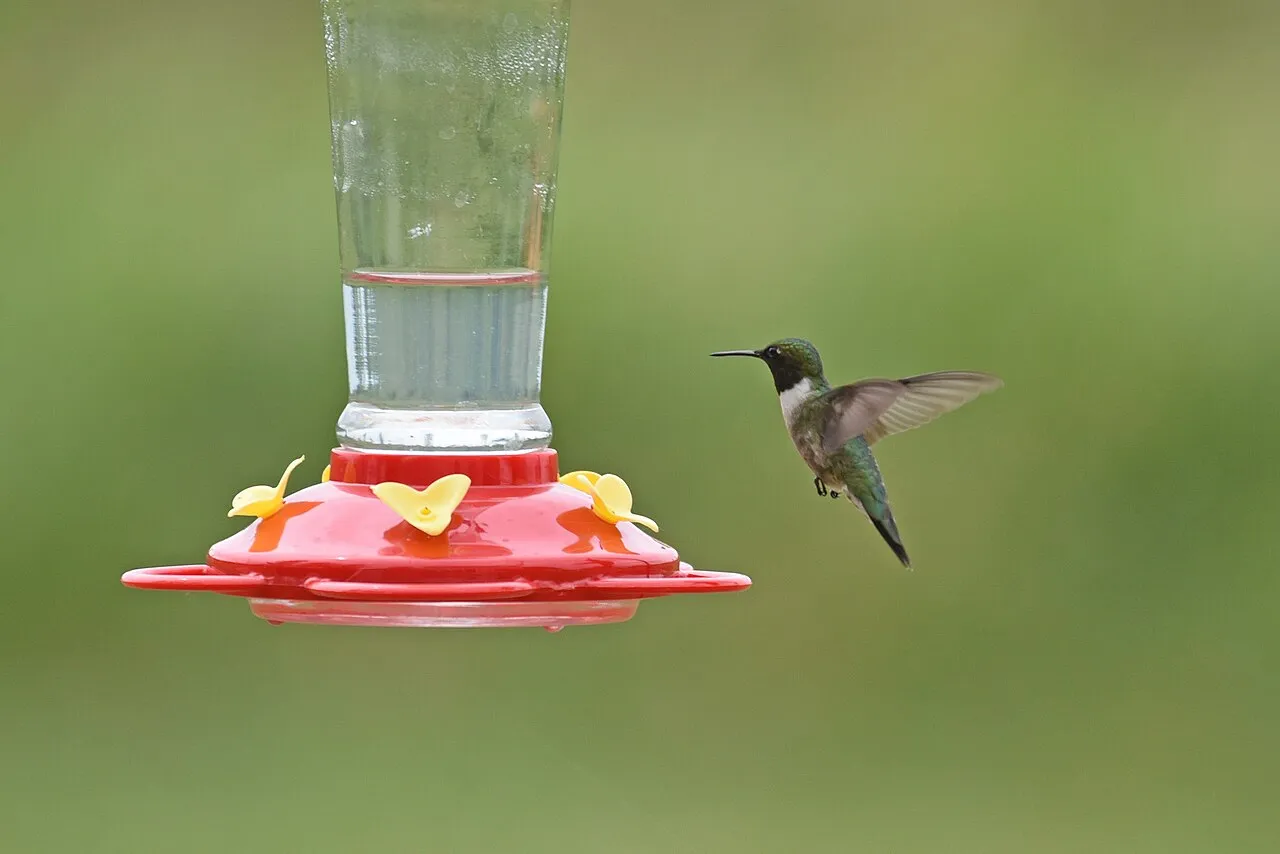
What the ruby-throated hummingbird in summer is doing
Females build the nest alone on a slender, often descending branch of a deciduous tree such as oak, hornbeam, birch, poplar or hackberry, usually 10–40 feet up; the nest takes 6–10 days, clutches are 1–3 eggs weighing about half a gram, incubated 12–14 days, with the young leaving after 18–22 days and 1–2 broods a year 3. Males aggressively defend flowers and feeders, leading to spectacular chases 3. They feed at tubular red and orange flowers — trumpet creeper, cardinal flower, honeysuckle, jewelweed, bee-balm — and catch insects in midair for protein 3.
Where to look for hummingbirds in summer
Ruby-throated Hummingbirds breed in deciduous woodlands of eastern North America and across the Canadian prairies, in old fields, forest edges, meadows, orchards, stream borders and backyards 3. Watch flower patches and feeders for the chases — males aggressively defend both — and slender, often descending branches of oaks, hornbeams, birches and poplars for the nest, usually 10–40 feet up 3. The eBird cards below show it as a bird of the eastern states on this site, replaced in Arizona, California, Colorado and Oregon by other hummingbird species 1.
Feeding hummingbirds in summer
Use about one-quarter cup of sugar per cup of water, no food coloring, and change it before it grows cloudy or discolored — in hot weather sugar water ferments rapidly to produce toxic alcohol 3. FeederWatch's rule is a cleaning every couple of days, ideally at every refill, and an immediate wash at any sign of cloudy water or black mold 2. Place feeders where cats cannot lie in wait and away from windows the birds might fly into 3.
eBird records by state: Ruby-throated Hummingbird, June–August
In June–August the Ruby-throated Hummingbird makes up the largest share of eBird records in Tennessee (1.9% of all records, against 0.79% across the year). The season raises its share above the annual figure in Tennessee, Michigan, Rhode Island, Texas, Florida. Records are eBird checklists reported 2020–2024 and retrieved through GBIF.
Frequently asked questions
Why did the male hummingbirds disappear in summer?
Males leave after mating and may begin migrating by early August, while females are still raising young 3.
Sources
- EOD – eBird Observation Dataset, Cornell Lab of Ornithology, via GBIF.org (CC BY 4.0); monthly records 2020–2024 for the nine states on this site
- Project FeederWatch (Cornell Lab of Ornithology) — Feeding Birds
- All About Birds (Cornell Lab of Ornithology) — Ruby-throated Hummingbird: Overview and Life History