Plant collection
Vines That Attract Birds
Two native vines cover the whole bird year between them: trumpet honeysuckle feeds hummingbirds from March and fruit-eaters in summer, and Virginia creeper feeds a dozen bird families through winter.
Growing facts are from the Wildflower Center's Native Plant Database, and the case for natives — including why these beat invasive Japanese honeysuckle and English ivy — is Audubon's 1.
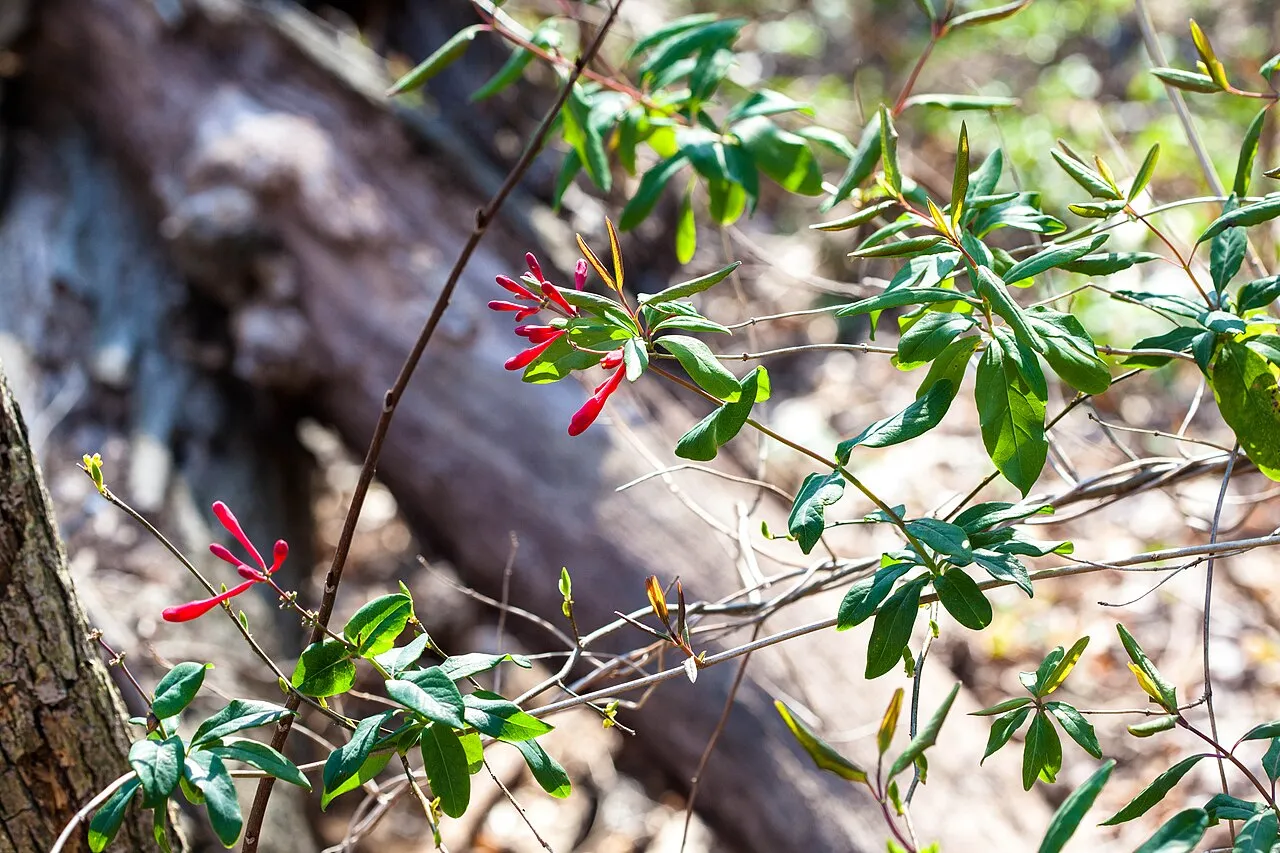
Vines that attract birds: trumpet honeysuckle
Lonicera sempervirens is a twining vine to 20 feet with red tubular flowers March–June that attract hummingbirds, bees and butterflies, and red berries that attract quail, Purple Finch, goldfinch, Hermit Thrush and American Robin 2. It needs light, air circulation and drainage against mildew, and flowers best in more sun 2.
Virginia creeper
Parthenocissus quinquefolia climbs by adhesive tendrils to 40 feet or carpets the ground; its bluish fruit feeds birds through the winter, including chickadees, nuthatches, mockingbirds, catbirds, finches, flycatchers, tanagers, swallows, vireos, warblers, woodpeckers and thrushes, and it hosts four sphinx moths 3. The berries are highly toxic to people, and the five-leaflet leaves are often confused with three-leaflet poison ivy 3.
Both vines are larval hosts, which matters as much as fruit: Audubon's point is that birds cannot survive without the insects that co-evolved with native plants 1.
Why native plants first
Native plants are those that occur naturally in the region where they evolved, and Audubon calls them the ecological basis on which birds depend: without them and the insects that co-evolved with them, local birds cannot survive 1. The scale matters — a native oak supports over 500 species of caterpillars where a ginkgo hosts five, and it takes more than 6,000 caterpillars to raise one brood of chickadees 1. Most nursery landscaping plants are alien species, so choosing natives is the single landscaping decision with the clearest effect on bird populations 1.
The alternative is what most yards already have. Audubon notes that manicured lawn now covers over 40 million acres of the United States as a green monoculture, that the traditional suburban lawn carries on average ten times more chemical pesticide per acre than farmland, and that the continental U.S. has lost 150 million acres of habitat and farmland to sprawl 1. Every bed of natives that replaces turf is habitat that lawn cannot be, and long-lived native trees such as oaks and maples also store carbon 1.
Check the native range before buying: the Wildflower Center record for this species lists the states and provinces where it occurs naturally 2, and Audubon's zip-code native plant database narrows that to your area and the bird groups each plant attracts 1. Once established, native plants generally need little maintenance and far less water than lawn, and they do not need the pesticides that make a yard poor bird habitat 1.
Each plant above links to its own profile with the Wildflower Center's native range, so you can confirm it occurs naturally where you live before buying 1.
More plant guides
Frequently asked questions
Which of these vines attracts hummingbirds?
Trumpet (coral) honeysuckle — its flowers attract hummingbirds, and it is native, unlike Japanese honeysuckle 2.
Is Virginia creeper good for birds, then?
Yes — its fruit feeds at least a dozen bird groups through winter; keep children away from the toxic berries 3.