Helianthus annuus · Asteraceae
Common Sunflower for Birds
Common sunflower is the wild parent of the black-oil sunflower in your feeder: a stout native annual up to 10 feet tall whose seeds are sought by many species of wild birds 1.
The growing facts below come from the Wildflower Center's record for Helianthus annuus 1; the native-plant case is Audubon's 2; bird diets from All About Birds 34 and feeder preferences from Project FeederWatch 5.
What common sunflower looks like
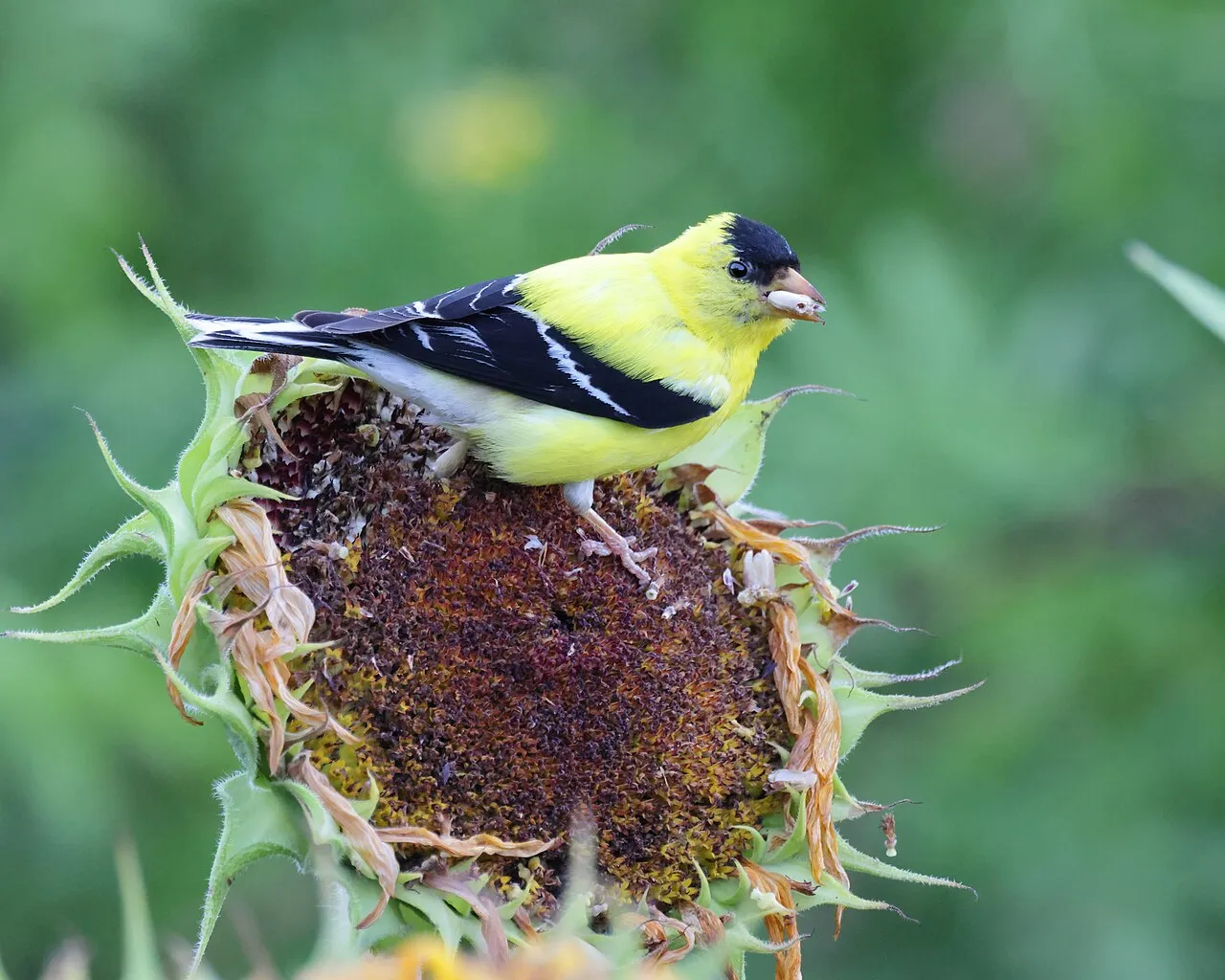
A widely branching, stout annual 1½ to 10 feet tall with coarsely hairy leaves and stems and large terminal flower heads up to 5 inches across, a maroon central disc ringed by bright yellow rays 1. It blooms July through October 1. The cultivated giant sunflower is a member of the same species, derived through artificial selection, and contrary to myth the mature heads do not follow the sun 1.
What common sunflower does for birds
Seeds are sought by many species of wild birds, and sunflowers intermixed with other annuals provide good cover for many species of wildlife 1. American Goldfinches eat seeds almost exclusively — composites such as sunflowers, thistle and asters — and balance on the seedheads to pluck them 3; Black-capped Chickadees take mostly sunflower seeds at feeders 4. FeederWatch calls black-oil sunflower the preferred food item for a wide variety of birds 5. Leave the heads standing into fall rather than deadheading.
Native range and growing conditions
Native from Manitoba and Minnesota to Texas and westward, naturalized to the Atlantic, in dry, open and disturbed areas 1. It wants full sun, dry disturbed clays or heavy sands, and medium water 1.
It spreads rapidly by seed, especially in disturbed sites, and has an allelopathic effect on other plants — give it its own bed rather than a mixed border 1.
Planting it for birds: native range and care
Check the native range before buying: the Wildflower Center record for this species lists the states and provinces where it occurs naturally 1, and Audubon's zip-code native plant database narrows that to your area and the bird groups each plant attracts 2. Once established, native plants generally need little maintenance and far less water than lawn, and they do not need the pesticides that make a yard poor bird habitat 2.
Native plants are those that occur naturally in the region where they evolved, and Audubon calls them the ecological basis on which birds depend: without them and the insects that co-evolved with them, local birds cannot survive 2. The scale matters — a native oak supports over 500 species of caterpillars where a ginkgo hosts five, and it takes more than 6,000 caterpillars to raise one brood of chickadees 2. Most nursery landscaping plants are alien species, so choosing natives is the single landscaping decision with the clearest effect on bird populations 2.
Birds this plant supports
More plant guides
Frequently asked questions
Which birds eat sunflower seeds from the plant?
Many wild birds seek the seeds; goldfinches and chickadees are the regulars, and cardinals, finches and sparrows favor sunflower at feeders 1345.
Is common sunflower native?
Yes, native from the Plains westward and naturalized east to the Atlantic 1.
Should I deadhead sunflowers?
Not if you want birds — leave the seed heads to ripen and dry on the stalk through fall.
Sources
- Lady Bird Johnson Wildflower Center, Native Plant Database — Helianthus annuus (USDA symbol HEAN3)
- National Audubon Society — Why Native Plants Matter
- All About Birds (Cornell Lab of Ornithology) — American Goldfinch: Overview and Life History
- All About Birds (Cornell Lab of Ornithology) — Black-capped Chickadee: Overview and Life History
- Project FeederWatch (Cornell Lab of Ornithology) — Feeding Birds