Lonicera sempervirens · Caprifoliaceae
Trumpet Honeysuckle for Birds
Trumpet honeysuckle (also called coral honeysuckle) is the native alternative to invasive Japanese honeysuckle: a slender twining vine whose red trumpet flowers attract hummingbirds and whose red berries feed quail, Purple Finch, goldfinch, Hermit Thrush and American Robin 1.
The growing facts below come from the Wildflower Center's record for Lonicera sempervirens 1; the native-plant rationale is Audubon's 2; hummingbird notes are from All About Birds 3.
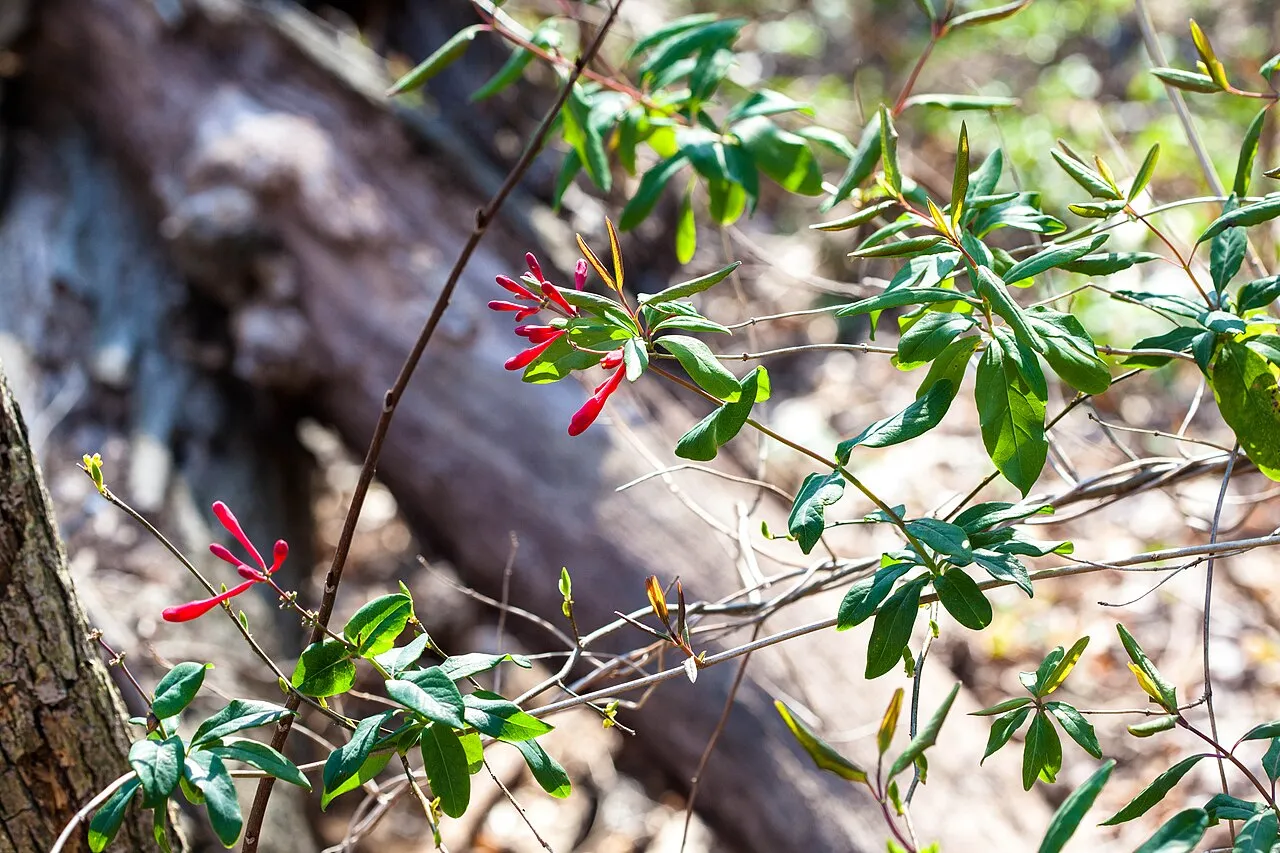
What trumpet honeysuckle looks like
A high-climbing, twining vine 3–20 feet long with smooth, glossy, paired, semi-evergreen leaves and clusters of red tubular blooms — red outside, yellow inside — followed by bright red berries about a quarter inch across 1. The bark is papery, orange-brown and exfoliating 1. It blooms March through June, and stems reach about 20 feet 1.
What trumpet honeysuckle does for birds
The flowers attract hummingbirds, bees and butterflies; the fruits attract quail, Purple Finch, goldfinch, Hermit Thrush and American Robin 1. All About Birds names honeysuckle among the tubular flowers Ruby-throated Hummingbirds feed at 3, and robins eat an enormous variety of fruit 4. It is also a larval host for the Spring Azure butterfly and Snowberry Clearwing moth, which means caterpillars — the food nesting songbirds need most 12.
Native range and growing conditions
Native from southern Maine to Florida and east Texas, scattered inland to Illinois, in zones 6 to 9 1. It takes sun or part shade, medium water and various soils, rich preferred, both lime and acid 1.
It needs light, good air circulation and adequate drainage to prevent powdery mildew, may need some structural help to begin climbing, flowers best with more sun, and tolerates poor drainage for short periods 1.
Planting it for birds: native range and care
Check the native range before buying: the Wildflower Center record for this species lists the states and provinces where it occurs naturally 1, and Audubon's zip-code native plant database narrows that to your area and the bird groups each plant attracts 2. Once established, native plants generally need little maintenance and far less water than lawn, and they do not need the pesticides that make a yard poor bird habitat 2.
Native plants are those that occur naturally in the region where they evolved, and Audubon calls them the ecological basis on which birds depend: without them and the insects that co-evolved with them, local birds cannot survive 2. The scale matters — a native oak supports over 500 species of caterpillars where a ginkgo hosts five, and it takes more than 6,000 caterpillars to raise one brood of chickadees 2. Most nursery landscaping plants are alien species, so choosing natives is the single landscaping decision with the clearest effect on bird populations 2.
Birds this plant supports
More plant guides
Frequently asked questions
Is trumpet honeysuckle invasive?
No — Lonicera sempervirens is native to the eastern United States, unlike the invasive Japanese honeysuckle; the Wildflower Center lists it as native in the lower 48 1.
Which birds eat trumpet honeysuckle berries?
Quail, Purple Finch, goldfinch, Hermit Thrush and American Robin, per the Wildflower Center; hummingbirds take the nectar 1.
Does trumpet honeysuckle need a trellis?
Usually some support to start climbing; it twines to about 20 feet and flowers best in more sun 1.
Sources
- Lady Bird Johnson Wildflower Center, Native Plant Database — Lonicera sempervirens (USDA symbol LOSE)
- National Audubon Society — Why Native Plants Matter
- All About Birds (Cornell Lab of Ornithology) — Ruby-throated Hummingbird: Overview and Life History
- All About Birds (Cornell Lab of Ornithology) — American Robin: Overview and Life History