Parthenocissus quinquefolia · Vitaceae
Virginia Creeper for Birds
Virginia creeper is the native vine with the longest bird list on this site: the Wildflower Center records its fruit feeding birds through the winter, including chickadees, nuthatches, mockingbirds, catbirds, finches, flycatchers, tanagers, swallows, vireos, warblers, woodpeckers and thrushes 1.
The growing facts below come from the Wildflower Center's record for Parthenocissus quinquefolia 1; the native-plant case is Audubon's 2.
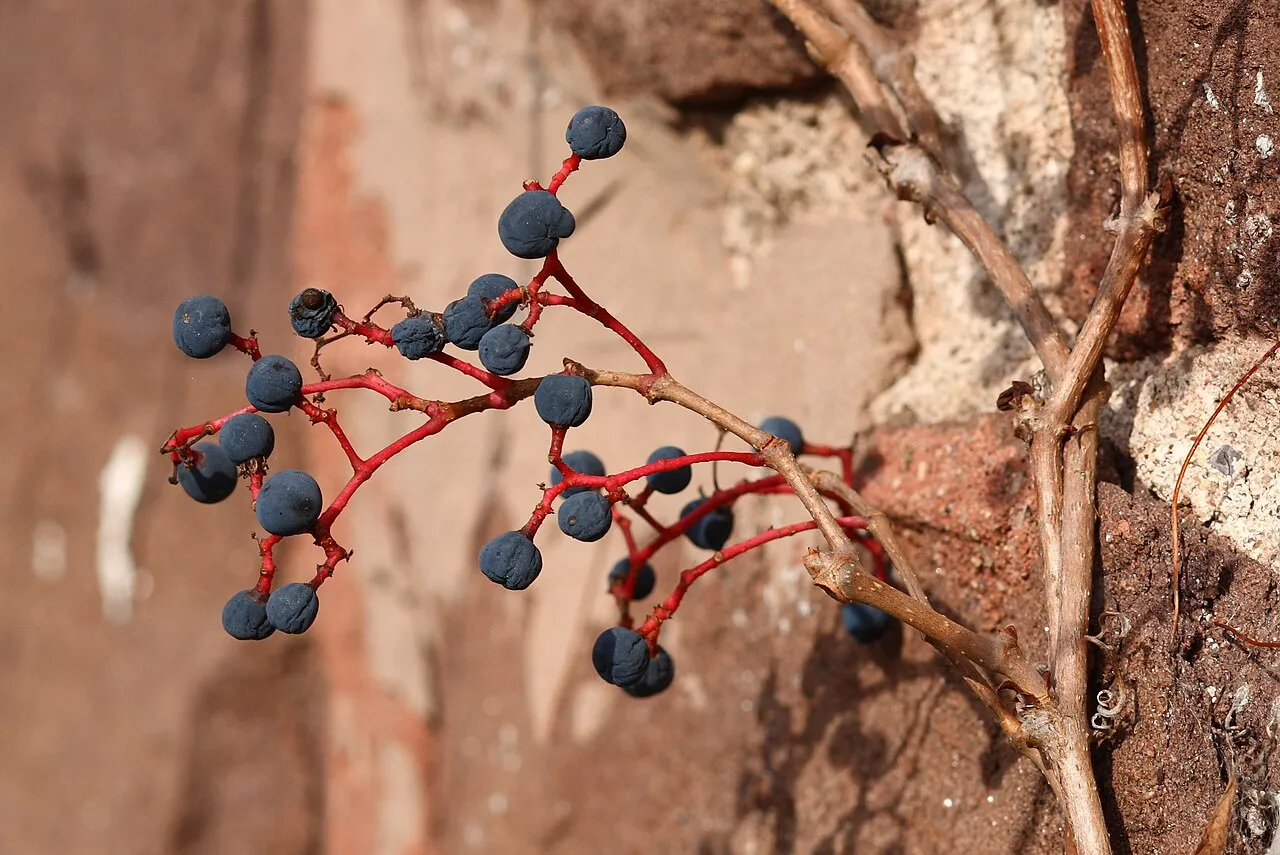
What Virginia creeper looks like
A woody deciduous vine, high-climbing or trailing 3–40 feet, that climbs by tendrils with adhesive discs that fasten to bark or rock 1. Leaves have five leaflets (occasionally three or seven) radiating from the petiole, coarsely toothed, turning brilliant mauve, red and purple early in fall; flowers are small and greenish in May–June, and the fruit is bluish, about a quarter inch 1. It is often confused with poison ivy, which has three leaflets 1.
What the vine does for birds
Fruit for birds through the winter — chickadees, nuthatches, mockingbirds, catbirds, finches, flycatchers, tanagers, swallows, vireos, warblers, woodpeckers and thrushes — and a larval host for several sphinx moths: Abbott's, Pandora, Virginia Creeper and White-lined 1. Those caterpillars are what native plants uniquely supply to nesting birds 2.
The berries are highly toxic to people and may be fatal if eaten, and the plant's tissues contain raphides that irritate some people's skin 1.
Native range and growing conditions
Native from Quebec and Ontario south to Florida, west to southeastern Minnesota and Texas, and on to Guatemala, in zones 5 to 11; habitats run from chaparral and open woodlands to shaded woods and streamsides 1. It tolerates most soils and climatic conditions — sun to shade, low water, moist well-drained soils of any texture — and works as a climbing vine or a ground cover; the structure it climbs is the limiting factor on size 1.
Planting it for birds: native range and care
Check the native range before buying: the Wildflower Center record for this species lists the states and provinces where it occurs naturally 1, and Audubon's zip-code native plant database narrows that to your area and the bird groups each plant attracts 2. Once established, native plants generally need little maintenance and far less water than lawn, and they do not need the pesticides that make a yard poor bird habitat 2.
Native plants are those that occur naturally in the region where they evolved, and Audubon calls them the ecological basis on which birds depend: without them and the insects that co-evolved with them, local birds cannot survive 2. The scale matters — a native oak supports over 500 species of caterpillars where a ginkgo hosts five, and it takes more than 6,000 caterpillars to raise one brood of chickadees 2. Most nursery landscaping plants are alien species, so choosing natives is the single landscaping decision with the clearest effect on bird populations 2.
Birds this plant supports
More plant guides
Frequently asked questions
Which birds eat Virginia creeper berries?
Chickadees, nuthatches, mockingbirds, catbirds, finches, flycatchers, tanagers, swallows, vireos, warblers, woodpeckers and thrushes, through the winter 1.
Are the berries poisonous?
The berries are highly toxic to people and may be fatal if eaten; tissues can irritate skin 1.
How do I tell Virginia creeper from poison ivy?
Virginia creeper has five leaflets (occasionally three or seven); poison ivy has three 1.