Fall · September–November
Fall Birds
Fall birds are birds in transition: hummingbirds and orioles leaving, goldfinches going dull, robins gathering into roosts, cardinals and chickadees forming the flocks that will visit feeders all winter 3456.
The behavior below is from All About Birds species accounts [3–8], feeding advice from Project FeederWatch 2, and the state-by-state numbers from eBird records on this site 1.
Fall birds that leave, and the ones that change
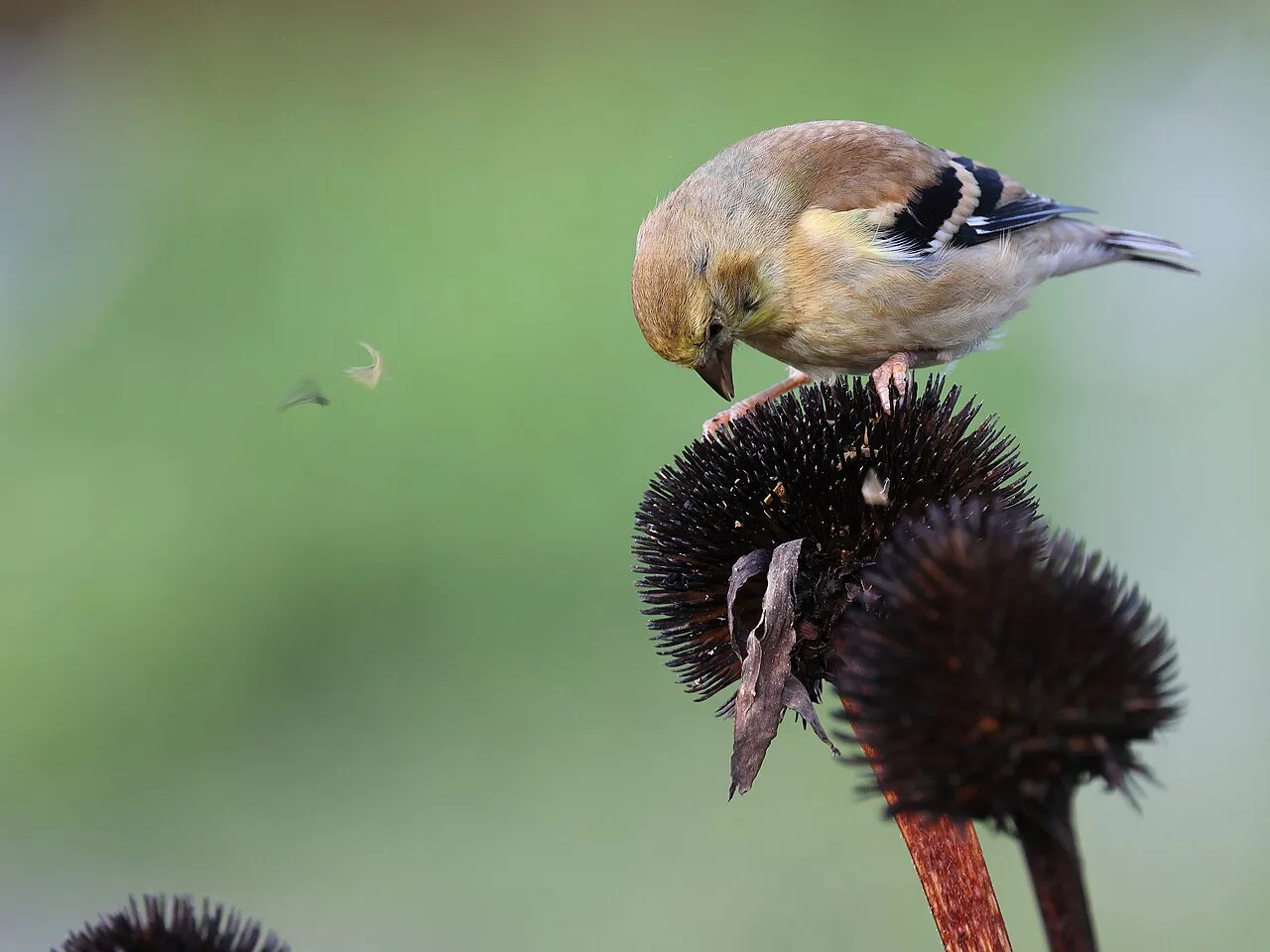
Ruby-throated Hummingbird males may begin migrating by early August, and the species winters in Mexico and Central America 3; Baltimore Orioles shift to nectar and ripe fruit in fall because their sugars convert readily to migration fat, then leave for Central America 4. American Goldfinches molt their body feathers in late summer, replacing the male's bright yellow with dull olive-brown, and in winter move south along a line that tracks a January minimum of about 0 °F 5. Thousands of Blue Jays migrate in flocks along the Great Lakes and Atlantic coasts, yet some stay all winter everywhere in the range, and the same bird may migrate one year and not the next 6.
Fall birds that flock up and stay
Northern Cardinals move in pairs during the breeding season but in fall and winter form flocks of a dozen to several dozen, sometimes foraging with juncos, sparrows, titmice and goldfinches 7. Black-capped Chickadees live in flocks that include woodpeckers, nuthatches, warblers and vireos, and because migrating songbirds join them, listening for chickadees in fall is a reliable way to find other species 8; they also begin hiding seeds to eat later, remembering thousands of spots 8. American Robins that stay north move to moist woods where berry-producing trees and shrubs are common and gather in roosts that can reach a quarter-million birds 9.
For the feeder, fall is when to restock: black-oil sunflower for the cardinals, chickadees and finches arriving, nyjer for goldfinches, siskins and redpolls, suet for the insect-eaters as insects vanish 2. Take hummingbird feeders down only after the last bird has gone; keep them clean every couple of days until then 2.
The most seasonal fall birds by state, from eBird
For each state with eBird data on this site, these are the backyard species whose share of September–November records rises most above their year-round share — the birds that are most a fall bird there. Records are eBird checklists reported 2020–2024, retrieved through GBIF.
Florida: Yellow Warbler (2.7× its annual share), Nashville Warbler (2.6× its annual share), Scarlet Tanager (2.5× its annual share), American Redstart (2.3× its annual share)
Arizona: American Redstart (2.7× its annual share), Nashville Warbler (2.6× its annual share), Yellow-bellied Sapsucker (2.2× its annual share), Fox Sparrow (2.1× its annual share)
California: Painted Bunting (2.9× its annual share), Scarlet Tanager (2.7× its annual share), Palm Warbler (2.5× its annual share), Black-and-white Warbler (2.1× its annual share)
Colorado: White-throated Sparrow (2.4× its annual share), Nashville Warbler (2.3× its annual share), Field Sparrow (1.9× its annual share), Orange-crowned Warbler (1.8× its annual share)
Oregon: Golden-crowned Kinglet (1.7× its annual share), Lincoln's Sparrow (1.6× its annual share), Great Egret (1.6× its annual share), Cackling Goose (1.5× its annual share)
Tennessee: Lincoln's Sparrow (2.9× its annual share), American Redstart (2.2× its annual share), Nashville Warbler (1.9× its annual share), Rose-breasted Grosbeak (1.9× its annual share)
Texas: Lewis's Woodpecker (2.2× its annual share), Northern Flicker (1.9× its annual share), Rufous Hummingbird (1.8× its annual share), Mountain Chickadee (1.8× its annual share)
Michigan: Golden-crowned Kinglet (2.6× its annual share), Lincoln's Sparrow (2.6× its annual share), Orange-crowned Warbler (2.1× its annual share), Fox Sparrow (2.1× its annual share)
Rhode Island: Lincoln's Sparrow (4.2× its annual share), Pine Siskin (3.4× its annual share), White-crowned Sparrow (2.8× its annual share), Palm Warbler (2.8× its annual share)
Fall guides by species
Frequently asked questions
When do hummingbirds leave in the fall?
Ruby-throated males may begin migrating by early August; females and young follow, and the species winters in Mexico and Central America 3.
Why do goldfinches turn brown in fall?
A late-summer molt replaces the male's yellow with olive-brown; a late-winter molt brings it back 5.
Do robins leave for the winter?
Many stay in their breeding range but roost in trees and feed on berries rather than lawns, so they seem to disappear 9.
Sources
- EOD – eBird Observation Dataset, Cornell Lab of Ornithology, via GBIF.org (CC BY 4.0); monthly records 2020–2024 for the nine states on this site
- Project FeederWatch (Cornell Lab of Ornithology) — Feeding Birds
- All About Birds (Cornell Lab of Ornithology) — Ruby-throated Hummingbird: Overview and Life History
- All About Birds (Cornell Lab of Ornithology) — Baltimore Oriole: Overview and Life History
- All About Birds (Cornell Lab of Ornithology) — American Goldfinch: Overview and Life History
- All About Birds (Cornell Lab of Ornithology) — Blue Jay: Overview and Life History
- All About Birds (Cornell Lab of Ornithology) — Northern Cardinal: Overview and Life History
- All About Birds (Cornell Lab of Ornithology) — Black-capped Chickadee: Overview and Life History
- All About Birds (Cornell Lab of Ornithology) — American Robin: Overview and Life History