How to attract birds
to your backyard
How to attract birds in five steps — food, water, native plants, nest sites and safety — built from Project FeederWatch, Audubon and eBird, with every claim linked to its source.
Start with your birds, your state or your feeder
Bird encyclopedia
Sourced profiles of the commonest backyard birds — cardinal, chickadee, goldfinch, robin, jay — plus the 1,000-species AOS checklist A–Z.
Browse the birds →Birds by state
A page for every state, with eBird records for nine so far: which birds are reported near you, in which months, and how often — so you attract what actually lives there.
Pick your state →Bird feeder tools
A feeder calculator, guides to every feeder type, and side-by-side comparisons that match feeder and food to the birds you want.
Open the feeder tools →How to attract birds in five steps
- 01 · FoodOffer the right food in the right feeder
Black-oil sunflower in a hopper or tube near cover is the seed most birds come for.
- 02 · WaterAdd water at ground level
A shallow bath with dripping water attracts birds that never visit a feeder.
- 03 · PlantsPlant natives in layers
Trees, fruiting shrubs, seed heads and leaf litter feed birds all year.
- 04 · Nest sitesGive birds somewhere to nest
Dense shrubs, dead wood and a well-built nest box keep birds that visit.
- 05 · SafetyRemove the two hazards
Make glass visible and keep cats indoors so the birds you attract survive.
The short version, with sources
How to attract birds comes down to supplying the four things every species needs — food, water, cover and a place to nest — and removing the two hazards that kill the birds you attract: glass and cats. Everything on this site is built from that list and from sources you can check.
Feeding and water advice comes from Project FeederWatch 12, window safety from All About Birds 3, planting from Audubon 45, and the state-by-state bird lists from eBird records retrieved through GBIF 6.
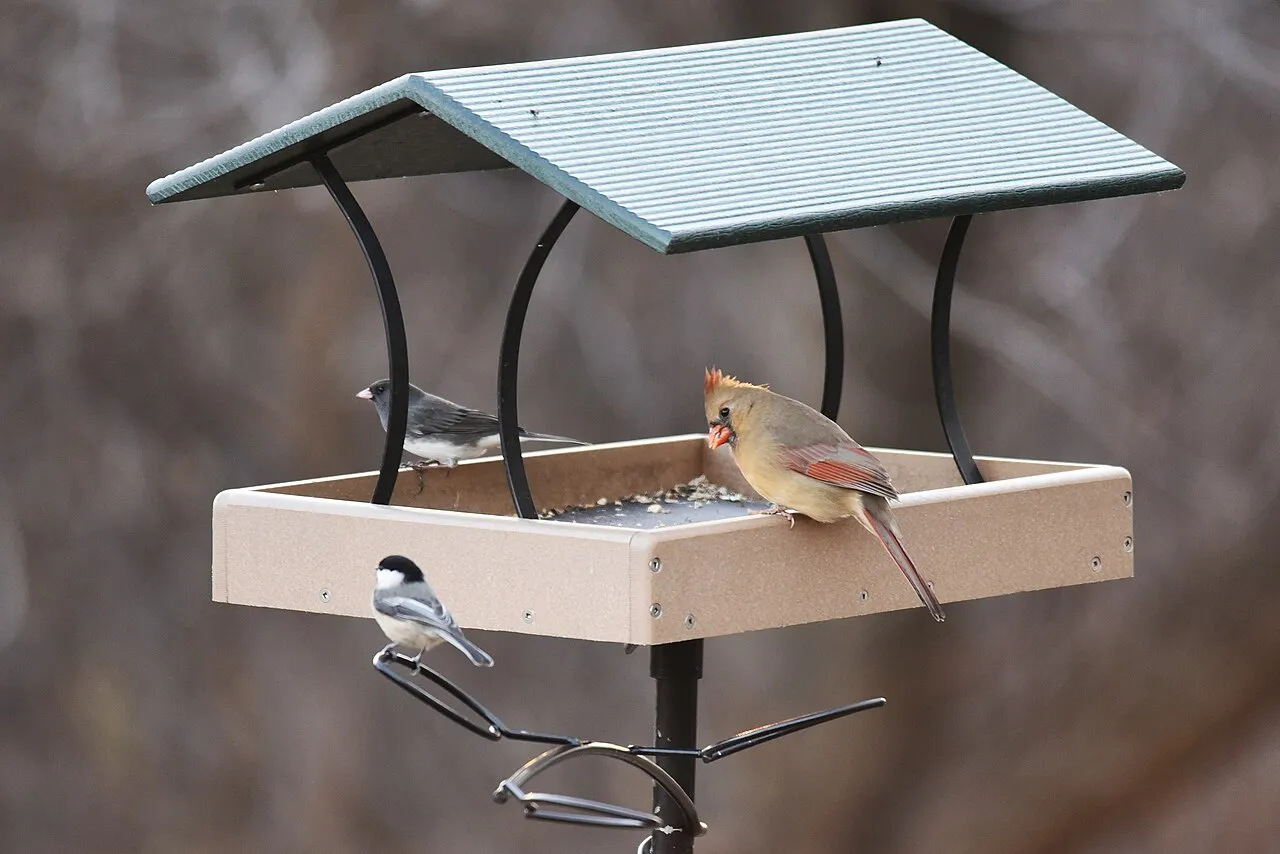
Step 1 — Food that attracts birds
The fastest way to attract birds is food they already prefer. Black-oil sunflower is the preferred food item for a wide variety of birds and a favorite of cardinals, chickadees, finches and sparrows; nyjer draws goldfinches, siskins and redpolls; millet and cracked corn feed the ground birds; suet brings woodpeckers, nuthatches and chickadees 1. Large hoppers attract most species, tubes with short perches keep to small birds and keep seed dry, and trays near the ground draw juncos, doves and sparrows 1.
Placement matters as much as seed. Put the feeder near cover such as trees or shrubs but about ten feet from branches squirrels can jump from, keep the seed dry, and clean the feeder every week or two — more often in wet weather — because leftover seed and hulls harbor pathogens 12. A new feeder can sit unvisited for days while birds find it by sight and by watching each other, so give it time before changing anything 1.
Step 2 — Water that attracts birds
Water works as well as seed, and it attracts species that never visit a feeder. Birds are attracted to water just as they are to feeders, prefer baths at ground level, and come fastest to dripping or moving water; keep the bath shallow — an inch or two — add a stone or branch so small birds can drink without getting wet, and change the water daily 1.
Step 3 — Native plants that attract birds
Nothing provides an easier or more dependable food supply than birdscaping with native vegetation 1. Audubon's method is habitat in layers — canopy trees, fruiting shrubs, seed-bearing perennials, and leaf litter for insects — with fruit staggered from serviceberry in summer to cedar and holly in winter 4; a native oak supports over 500 caterpillar species against five for a ginkgo, and a chickadee brood needs more than 6,000 caterpillars 5.
Cover is what turns a visit into a habit. Feeder birds want evergreens or dense shrubs within a short flight of the food, ground birds want a brush pile to dive into, and fledglings need thickets to hide in — so leave some of the yard untidy, and lay off pesticides that remove the insects nestlings are fed 14.
Step 4 — Nest sites for the birds you attract
Food and water bring birds through; nest sites keep them. Shrubs and small trees hold songbird nests, dead trees and limbs left standing where they are safe give woodpeckers and chickadees cavities, and a nest box built to the right dimensions — with ventilation, drainage, no perch and a guard against predators — adds the fourth thing cavity nesters need 4. Which birds nest in your area, and when, is in the state pages below.
Step 5 — Keep attracted birds safe
Window collisions kill perhaps a billion or more birds a year in North America, and older rules about safe feeder-to-window distances are no longer thought valid; make glass near feeders visible with markings no more than 2 inches apart, exterior screens or hanging cords 3. Cats kill hundreds of millions of birds a year — keep them indoors 1. If birds with swollen eyes or fluffed, lethargic postures appear, take feeders down for a couple of weeks and disinfect them 2.
Birds you can attract in your state
Which birds you can attract depends on where you live, so this site's state pages are built from eBird checklists reported 2020–2024 and retrieved through GBIF 6: for each of nine states so far — Florida, Arizona, California, Colorado, Oregon, Tennessee, Texas, Michigan and Rhode Island — the most-reported backyard species, their month-by-month presence, and pages for hummingbirds, woodpeckers, owls, hawks, warblers, sparrows, wrens, finches, doves, ducks, herons, jays, chickadees, orioles, magpies and eagles. Bird profiles draw on the Cornell Lab's All About Birds, and the species catalog follows the American Ornithological Society checklist 7.
How to attract birds in every situation
Attract birds that live in your state
A cardinal feeder in California will stay empty, and a Michigan yard will never see an Anna's Hummingbird. Every state has a page, and nine so far rank the most-reported backyard birds from eBird checklists 6, month by month, so you attract birds that are actually there.
Backyard birds you can attract
Bird feeder tools that attract more birds
Bird feeder calculator
Enter yard size, target birds and budget; get feeder count, type and seed per week.
→Feeder types and the birds they attract
Hopper, tube, platform, suet, nyjer mesh, window and hummingbird feeders — placement, cleaning and squirrels.
→Compare feeders for your birds
Tube vs hopper, platform vs tube, suet vs seed — which attracts more of the birds you want.
→Bird food that attracts each species
FeederWatch's ranking of sunflower, safflower, nyjer, millet, peanuts, suet and nectar.
→Plan a yard
that attracts birds
Tell us where you live and which birds you want to attract. We'll generate a tailored plan — native plants, feeder types, water sources, and a seasonal checklist.
- ✓ Local bird recommendations
- ✓ Region-native plant choices
- ✓ Feeder + water source plan
- ✓ Seasonal care checklist
Questions about attracting birds
What is the fastest way to attract birds to a backyard?
A feeder of black-oil sunflower near cover plus a shallow bird bath with dripping water — the two resources FeederWatch says draw birds most reliably 1.
How long does it take to attract birds to a new feeder?
Anywhere from a day to a few weeks. Birds find feeders by sight and by watching other birds, so a feeder near cover in a yard that already has birds fills fastest; keep the seed fresh and dry while you wait 1.
Do I need a feeder to attract birds?
No. FeederWatch says feeders are not the only way, or even the best way, to feed birds; native plants supply insects, fruit and seed more dependably 14.
How do I keep the birds I attract from hitting windows?
Distance rules are no longer considered valid; instead make the glass visible with 2-inch-spaced markings, screens or cords 3.
How do I attract birds to a balcony or small yard?
A window or railing feeder, a shallow dish of water and a few native plants in containers; Audubon notes even very small patches of habitat help migrating birds 4.
Sources on attracting birds
- Project FeederWatch (Cornell Lab of Ornithology) — Feeding Birds: feeders, foods, water, placement, cleaning and safety
- Project FeederWatch — Sick Birds and Bird Diseases
- All About Birds (Cornell Lab of Ornithology) — Why Birds Hit Windows, and How You Can Help Prevent It
- National Audubon Society — How to Make Your Yard Bird-Friendly
- National Audubon Society — Why Native Plants Matter
- EOD – eBird Observation Dataset, Cornell Lab of Ornithology, via GBIF.org (CC BY 4.0); state records 2020–2024
- American Ornithological Society — Checklist of North and Middle American Birds (taxa list, accessed 2026-08-11)